


In the landscape of modern enterprise, the gap between technical implementation and business strategy often leads to friction. Architects build systems, but executives fund them. When the language of the builder does not match the language of the investor, projects stall, budgets shrink, and innovation slows. This guide provides a structured approach to bridging that divide without diluting technical accuracy or overselling outcomes.
Enterprise architecture is not just about servers, code, or databases. It is about the structural integrity of the organization’s ability to deliver value. When you present architectural decisions to leadership, you are not asking for permission to write code; you are proposing a strategic direction that impacts revenue, risk, and operational velocity. Understanding this distinction is the first step toward effective communication.
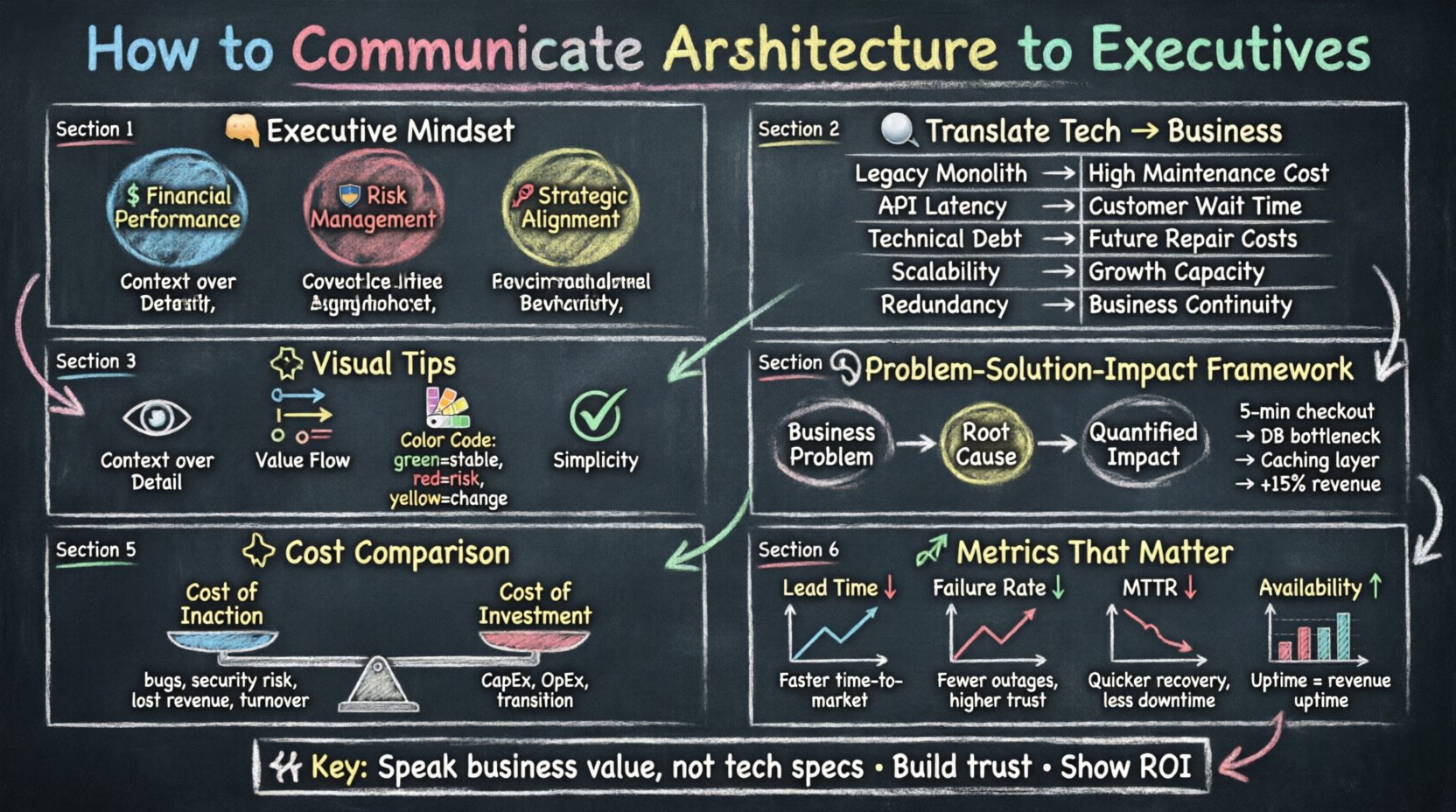
🧠 Understanding the Executive Mindset
Executives operate under different constraints than technical teams. Their primary concerns usually revolve around three core pillars: financial performance, risk management, and strategic alignment. They are not interested in the specific library version or the latency of an API call. They are interested in how those details affect the bottom line.
- Financial Performance: How does this investment impact the P&L? What is the return on investment?
- Risk Management: What happens if we do nothing? What are the compliance implications?
- Strategic Alignment: Does this support the company’s long-term goals?
When you frame your architectural discussions around these pillars, you signal that you understand the business context. You transition from being a technical resource to a strategic partner.
🗣️ Translating Technical Jargon into Business Value
The most common barrier to communication is vocabulary. Terms like microservices, latency, or technical debt often carry negative or confusing connotations for non-technical leaders. The goal is not to dumb down the information, but to translate the technical reality into business consequence.
Consider the following table to see how specific technical terms map to business concepts:
| Technical Term | Business Equivalent | Why it Matters |
|---|---|---|
| Legacy Monolith | High Maintenance Cost Structure | Prevents rapid adaptation to market changes. |
| API Latency | Customer Wait Time | Directly impacts user satisfaction and conversion rates. |
| Technical Debt | Future Repair Costs | Accumulating interest on short-term fixes that block future work. |
| Scalability | Capacity for Growth | Ability to handle increased demand without service failure. |
| Redundancy | Business Continuity | Ensures operations continue during disruptions. |
Using these translations ensures clarity. For instance, instead of saying “We need to refactor the monolith to microservices”, try “We need to decouple our systems to allow independent updates and faster feature deployment”.
📊 The Power of Visual Communication
Humans process visual information significantly faster than text. However, architectural diagrams can be just as dense and confusing as code if not designed with the audience in mind. Executives do not need to see every interface or database table.
Principles for Effective Diagrams
- Context over Detail: Show how the system fits into the broader ecosystem, not just the internal components.
- Focus on Value Flow: Use arrows to show where value is created or where friction exists.
- Color Coding: Use color to highlight status (e.g., green for stable, red for high risk, yellow for planned change).
- Simplicity: If a diagram requires a legend to be understood, it is too complex.
When presenting a diagram, walk the executive through the narrative first, then show the visual. The visual should reinforce the story, not replace it. Start with the problem, show the current state visually, and then overlay the proposed state.
📖 Structuring the Narrative
A presentation or proposal is a story. It needs a beginning, middle, and end. The structure dictates how the information is received. A common pitfall is starting with the technical solution before establishing the problem.
The Problem-Solution-Impact Framework
- Identify the Business Problem: Start with a metric or a strategic goal. Example: “Our current checkout process takes 5 minutes, leading to cart abandonment.”
- Explain the Root Cause: Briefly touch on the technical constraint. Example: “The database architecture cannot handle the current read/write patterns efficiently.”
- Propose the Solution: Describe the architectural change. Example: “Implementing a caching layer will reduce database load.”
- Quantify the Impact: State the business outcome. Example: “This will reduce checkout time to 30 seconds, potentially increasing revenue by 15%.”
This structure keeps the focus on value. It prevents the conversation from drifting into implementation details unless the executive specifically asks for them.
💰 Aligning Architecture with Financial Metrics
Speaking the language of finance is crucial for securing budget. Architects often hesitate to discuss money, but business leaders expect it. You must be able to articulate the cost of inaction versus the cost of investment.
Cost of Inaction
This is the cost of maintaining the status quo. It includes:
- Maintenance Overhead: Hours spent fixing bugs in old systems that could be spent on new features.
- Security Vulnerabilities: The risk of a breach due to outdated infrastructure.
- Opportunity Cost: Revenue lost because new features cannot be released quickly enough.
- Employee Attrition: High technical debt often leads to engineer burnout and turnover.
Cost of Investment
Be transparent about what the investment entails. Break it down into:
- Capital Expenditure (CapEx): Upfront costs for infrastructure or development time.
- Operational Expenditure (OpEx): Ongoing costs for licensing, hosting, or maintenance.
- Transition Period: Acknowledge that performance may dip during migration and plan accordingly.
Presenting a comparison of these two costs helps executives make a rational decision based on risk and return.
🛡️ Addressing Risk and Technical Debt
Technical debt is often misunderstood as a purely technical issue. In reality, it is a financial and operational risk. When communicating this to leadership, avoid apologizing for the debt. Instead, present it as a managed liability.
- Inventory the Debt: Create a list of known debts and their estimated impact. Treat them like financial liabilities.
- Categorize by Risk: High risk items (security flaws, single points of failure) require immediate attention. Low risk items (code style, minor refactoring) can be deferred.
- Propose a Paydown Strategy: Allocate a percentage of capacity each quarter to reduce debt. This shows a proactive plan rather than a reactive crisis.
When a leader asks why a new feature is delayed, the answer should not be “We are refactoring”. It should be “We are reducing the risk of system failure to ensure the feature is stable upon release”.
🤝 Handling Objections and Questions
Even the best-prepared proposals face resistance. Executives may question the necessity of the change or the timeline. The key is to remain calm and factual.
Common Objections and Responses
| Objection | Underlying Concern | Recommended Response |
|---|---|---|
| “Why can’t we just wait?” | Urgency vs. Cost | Explain the compounding cost of delay and the increasing complexity of future fixes. |
| “Is this vendor lock-in?” | Flexibility | Discuss abstraction layers and data portability strategies to mitigate lock-in risks. |
| “Can’t we do it cheaper?” | Budget Constraints | Offer phased approaches that deliver value incrementally, reducing upfront financial exposure. |
| “Is this necessary now?” | Priority | Link the change directly to an upcoming business event or compliance deadline. |
Always return the conversation to the business goal. If the goal is speed, explain how the architecture enables speed. If the goal is stability, explain how the architecture ensures reliability.
🔄 Establishing Feedback Loops
Communication is not a one-time event. It is an ongoing cycle. Architecture evolves, and so do business needs. Establishing regular touchpoints ensures alignment is maintained.
- Quarterly Architecture Reviews: A scheduled session to review the roadmap against business objectives.
- Decision Records: Document major architectural decisions (ADRs) to provide context for future changes. This creates a historical record of why a choice was made.
- Stakeholder Interviews: Regularly check in with business leaders to understand shifting priorities before they become formal requirements.
Documentation serves as a single source of truth. When an executive asks about a decision made six months ago, the record provides the rationale without needing to dig through meeting minutes.
📈 Metrics That Matter
Just as executives track sales and marketing metrics, architects should track architectural health metrics that correlate with business outcomes. Avoid vanity metrics like “lines of code” or “test coverage percentage”.
Instead, focus on:
- Lead Time for Changes: How long does it take to get a change into production? This measures agility.
- Change Failure Rate: How often do deployments cause incidents? This measures stability.
- Mean Time to Recovery (MTTR): How quickly can the system recover from a failure? This measures resilience.
- System Availability: Uptime percentages directly correlate to revenue availability.
Presenting these metrics allows executives to see the architectural team’s performance in terms of efficiency and reliability. It shifts the perception from “cost center” to “efficiency driver”.
🚀 Navigating Change Management
Architecture changes often require organizational change. A new system might require new skills or different workflows. Ignoring the human element of change management can derail even the best technical strategy.
Identify the key influencers within the organization. These are not always the managers; they might be senior engineers or long-tenured staff. Engage them early. Their buy-in can smooth the transition for the rest of the organization.
Communicate the benefits to the individual, not just the company. For example, “This new tool will reduce the manual reporting you do every week” is more effective than “This tool optimizes data flow”.
🔗 Building Long-Term Trust
Trust is the currency of effective communication. It is built over time through consistency and honesty. If you say you will deliver a milestone by a certain date, meet that date. If you identify a risk early, flag it immediately.
- Be Honest About Uncertainty: If a timeline is rough, say so. Provide a range rather than a false precision.
- Admit Mistakes: If a decision was wrong, acknowledge it and present the correction plan. This builds credibility.
- Deliver Predictably: Consistency in communication style and delivery cadence reduces anxiety among stakeholders.
When trust is established, executives are more likely to listen to your advice during crises. They will understand that your technical recommendations are grounded in a deep understanding of the business risks.
🏁 Summary of Best Practices
To summarize, communicating complex architecture to business executives requires a deliberate shift in focus. You must move from the how to the why. You must translate technical constraints into business risks and opportunities. You must use visuals to clarify, not confuse. And you must measure success in terms of value delivered, not lines of code written.
By adopting these strategies, you position yourself not just as an architect of systems, but as an architect of business outcomes. This alignment is essential for sustainable growth and effective enterprise transformation.