


In the modern enterprise landscape, the divide between business objectives and technology execution often widens into a chasm. When strategic goals set by leadership fail to translate into actionable technical roadmaps, the organization suffers from inefficiency, wasted capital, and missed market opportunities. This is not merely a communication breakdown; it is a structural issue within the Enterprise Architecture.
Aligning these two critical functions requires more than just regular meetings. It demands a rigorous framework for decision-making, clear visibility into capabilities, and a shared language for value. This guide provides a comprehensive examination of troubleshooting these mismatches. We will explore the root causes, identify symptoms, and outline a path toward sustainable synchronization.
Understanding the Strategic Disconnect 🧐
Business units focus on revenue, customer experience, and speed to market. IT departments focus on stability, security, scalability, and technical debt reduction. Neither perspective is incorrect; they are simply looking at the organization through different lenses. The friction arises when the lens of one is treated as the dominant reality for the other.
To resolve misalignment, we must first acknowledge that technology is not a support function but a strategic enabler. Conversely, business strategy cannot exist in a vacuum if it ignores technical constraints and realities. The goal is not to force one side to submit to the other, but to create a unified view of enterprise capability.
The Cost of Misalignment
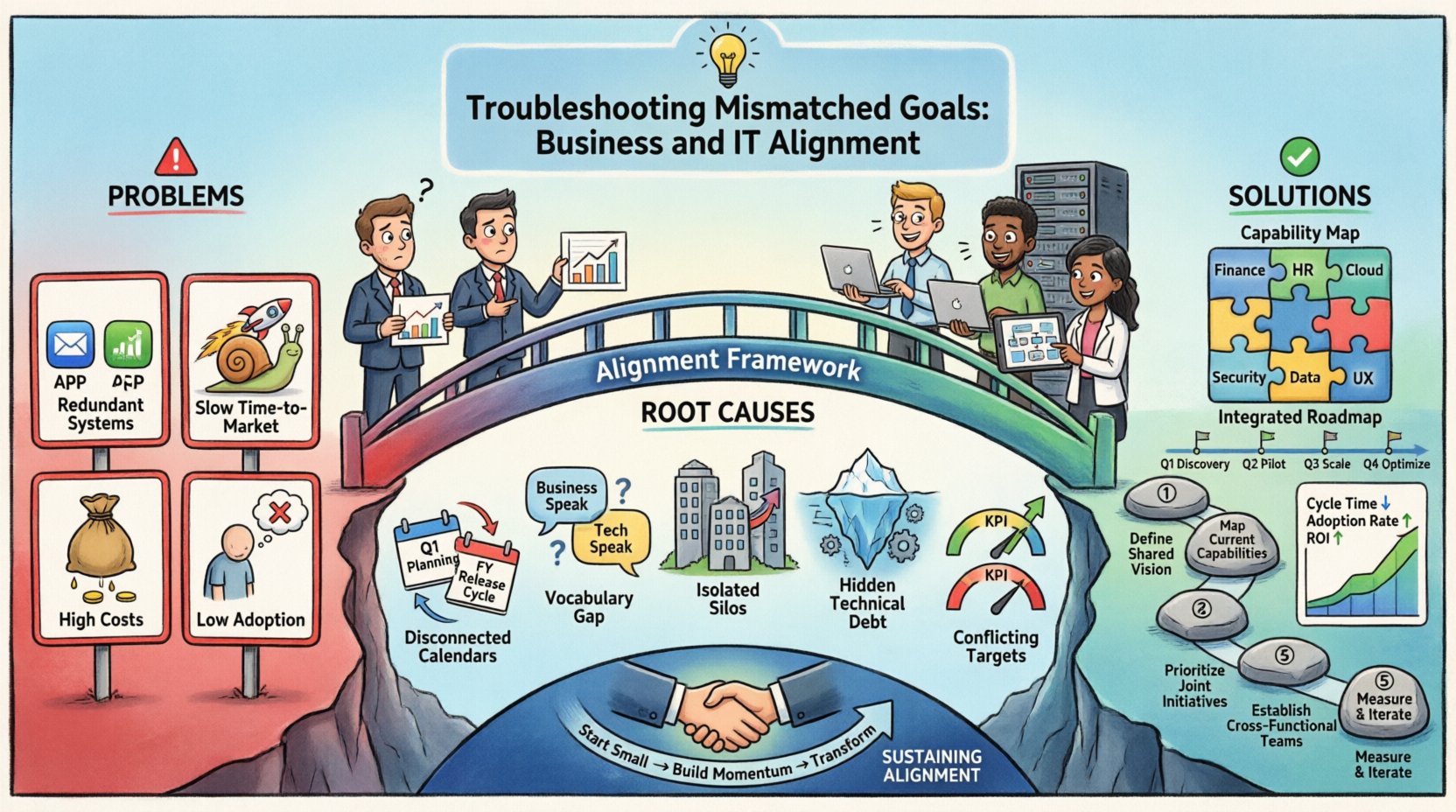
When goals remain mismatched, the financial and operational impact is significant. Organizations frequently encounter scenarios where:
- Redundant Systems: Multiple departments purchase similar tools because they lack visibility into existing assets.
- Slow Time-to-Market: Business ideas stall because technical dependencies were not accounted for in the planning phase.
- High Maintenance Costs: Legacy systems are kept alive to support specific business units without a plan for modernization.
- Low User Adoption: Solutions are built that do not fit the actual workflow of the employees.
Identifying Symptoms of Misalignment 🚩
Before implementing solutions, leadership must recognize the warning signs. These indicators often appear as recurring friction points or strategic blind spots. The following table outlines common symptoms and their underlying implications.
| Observation | Implication | Severity |
|---|---|---|
| IT is constantly put on the defensive | IT is viewed as a blocker rather than a partner | High |
| Projects consistently exceed budget | Scope creep and poor initial requirement gathering | High |
| Business units shadow IT | Departments buying their own SaaS solutions without oversight | Medium |
| Low satisfaction scores from business stakeholders | Deliverables do not meet actual business needs | Medium |
| IT roadmap does not match annual business plan | Strategic planning processes are disconnected | High |
| Frequent rework of software features | Requirements change mid-stream due to lack of understanding | Medium |
Root Causes of the Gap 🔍
Addressing symptoms without fixing the cause is like treating a fever without diagnosing the infection. The following sections detail the structural reasons why business and IT alignment often fails.
1. Disconnected Planning Cycles
Business strategy is typically planned annually or quarterly. IT architecture and infrastructure planning often operate on different timelines, sometimes multi-year. When these cycles do not intersect, business initiatives are launched before technical feasibility is validated. This leads to a reactive posture where IT scrambles to catch up with demands that were not scoped correctly.
2. Lack of Shared Vocabulary
Business leaders speak in terms of ROI, market share, and customer retention. Architects speak in terms of latency, throughput, and API governance. Without a translation layer, stakeholders assume they understand each other when they do not. This linguistic gap creates false expectations regarding delivery dates and system capabilities.
3. Siloed Governance
Governance boards often operate in isolation. A Business Architecture board may approve a project without input from the Technology Architecture board. This results in approved initiatives that are technically unsustainable or violate security policies downstream. Decentralized decision-making without central oversight leads to fragmentation.
4. Hidden Technical Debt
Business stakeholders often do not understand that fixing a bug or upgrading a database takes time and resources that could otherwise be used for new features. When technical debt is invisible to business leadership, they demand innovation while the foundation crumbles. This creates a cycle of burnout and instability.
5. Incentive Misalignment
KPIs for business teams focus on sales and growth. KPIs for IT teams focus on uptime and security. These metrics can conflict. For example, a security team might block a rapid deployment to ensure safety, while the business team is penalized for delay. Without aligned incentives, teams work against each other.
Establishing a Unified Framework 🛠️
To resolve these issues, an organization must adopt a structured approach to Enterprise Architecture. This does not require specific software tools, but rather a disciplined methodology for organizing information and decisions.
The Capability Mapping Approach
Shift the conversation from “systems” to “capabilities.” A capability is what the business does (e.g., “Process Payments” or “Manage Customer Accounts”), not the technology that does it. By mapping capabilities to business outcomes, IT can see exactly which applications support which revenue streams.
- Identify Core Capabilities: List the essential functions required to run the business.
- Map Applications: Connect existing software to these capabilities.
- Identify Gaps: Determine where capabilities lack technological support.
- Assess Health: Rate the technical health of the supporting applications.
Integrated Roadmapping
Develop a single source of truth for the organization’s future state. This roadmap should integrate business initiatives with technical enablers. It should show not just what is being built, but why, and what infrastructure is required to support it.
This process requires transparency. The roadmap should be visible to all stakeholders. It prevents the “black box” syndrome where business assumes IT is working on something that is actually not a priority.
Implementation Steps for Realignment 🚀
Changing the culture and process of an organization takes time. The following steps provide a logical sequence for improving alignment without disrupting daily operations.
Step 1: Stakeholder Analysis and Engagement
Identify the key decision-makers in both business and IT. These are not just the C-suite, but also the directors and managers who execute the strategy. Establish a cross-functional steering committee. This group meets regularly to review the alignment between business plans and technical capacity.
Step 2: Standardize Requirements Gathering
Implement a standardized process for capturing business requirements. This process must include technical feasibility checks at the earliest stage. Every request should answer: “Does this align with our architectural principles?” and “What is the technical cost?”
Step 3: Implement Value Stream Management
Focus on the flow of value from idea to customer. Map the steps required to deliver value and identify where business and IT handoffs occur. Optimize these handoffs to reduce friction. This often involves adopting agile practices that include business stakeholders in the sprint planning.
Step 4: Budget Co-Ownership
Move away from IT being a cost center that is allocated a budget. Instead, adopt a model where business units contribute to the technology budget based on their usage and strategic importance. This forces business leaders to consider the cost of technology when planning initiatives.
Step 5: Communication Protocols
Establish regular cadence for updates. Quarterly Business Reviews should include technical health reports. Conversely, IT status updates should include business impact assessments. Avoid technical jargon in business meetings and business jargon in technical meetings.
Measuring Success and KPIs 📊
You cannot improve what you do not measure. To ensure alignment is improving, track metrics that reflect the health of the relationship between business and IT.
- Strategic Initiative Delivery Rate: Percentage of business initiatives delivered on time and within budget.
- System Availability vs. Business Demand: Does the infrastructure support the business peaks?
- Shadow IT Reduction: Decrease in unsanctioned software purchases.
- Employee Satisfaction: Surveys measuring business team satisfaction with IT support.
- Time to Value: How long does it take from idea to production?
Sustaining the Alignment Culture 🌱
Once the structural issues are resolved, the focus must shift to culture. Alignment is not a project with an end date; it is a continuous state of being. It requires ongoing attention to the human elements of the organization.
Shared Goals and Rewards
Link the performance bonuses of IT leaders to business outcomes. If the company misses its revenue target due to technical failures, IT leadership should share in that accountability. Similarly, if business units succeed due to IT innovation, IT should be recognized. This creates a partnership dynamic rather than a vendor-client dynamic.
Continuous Learning
Business leaders need basic technical literacy to understand constraints. IT leaders need business acumen to understand market pressures. Implement cross-training programs where IT staff shadow business units, and business leaders visit technical operations. This builds empathy and reduces the “us vs. them” mentality.
Adaptability
The market changes, and so must the architecture. A rigid architecture resists change and causes friction. An agile architecture allows for rapid pivoting. Ensure your Enterprise Architecture is documented in a way that allows for modification without breaking the entire system. This flexibility is key to maintaining alignment in a volatile environment.
Addressing Specific Scenarios ⚖️
Real-world situations often present unique challenges. Here are common scenarios and how to approach them.
Scenario A: The “Innovation vs. Stability” Conflict
Business wants to launch a new feature quickly. IT wants to ensure the code is secure and stable.
Solution: Implement a risk-based approach. Define what “fast” means in terms of acceptable risk. Create a “safe to fail” environment for experiments while keeping core systems stable. Use feature flags to control exposure.
Scenario B: The Budget Cut
Leadership cuts the IT budget, but business demands more services.
Solution: Use the capability map to identify low-value activities. Cut the technology that does not support core business goals. Communicate clearly that resources are finite and must be prioritized based on strategic value.
Scenario C: Merger and Acquisition
Two companies merge, bringing two different IT landscapes and business cultures.
Solution: Do not rush integration. Audit the capabilities of both sides first. Identify redundancies and synergies. Plan the technology convergence as a separate project from the business integration to avoid overwhelming the organization.
The Role of Governance in Alignment 🏛️
Governance is the mechanism that ensures alignment persists over time. It is not about bureaucracy; it is about clarity. A good governance framework defines who decides what, and how decisions are made.
- Architecture Review Boards: A group that reviews major projects to ensure they fit the long-term strategy.
- Change Management: A process for evaluating the impact of changes on the business.
- Data Governance: Ensuring data is managed consistently across the enterprise, supporting both business and IT needs.
- Vendor Management: Ensuring third-party tools align with the internal strategy.
Conclusion on Continuous Improvement
Resolving business and IT alignment issues is a journey of continuous improvement. It requires a commitment to transparency, a willingness to share power, and a focus on shared value. By understanding the root causes, implementing structured frameworks, and maintaining a culture of partnership, organizations can turn the relationship between business and technology into a competitive advantage.
The path forward involves regular audits of the alignment, updating the capability maps, and fostering open dialogue. When business and IT operate as a single organism, the organization becomes more resilient, responsive, and capable of achieving its strategic vision.
Start by auditing your current state. Identify one symptom from the table above and address it this quarter. Small wins build the momentum needed for larger transformation. The technology is ready; the strategy is clear. Now, execute.
Related posts:
 The Beginner’s Guide to Enterprise Architecture: A Definitive Overview
 Enterprise Architecture Explained: A Step-by-Step Quick Start for New Architects
 Business, Data, and Technology: Breaking Down the Core Components of Enterprise Architecture
 Solution Architect’s Checklist: Essential Steps Before Starting Your First EA Project