


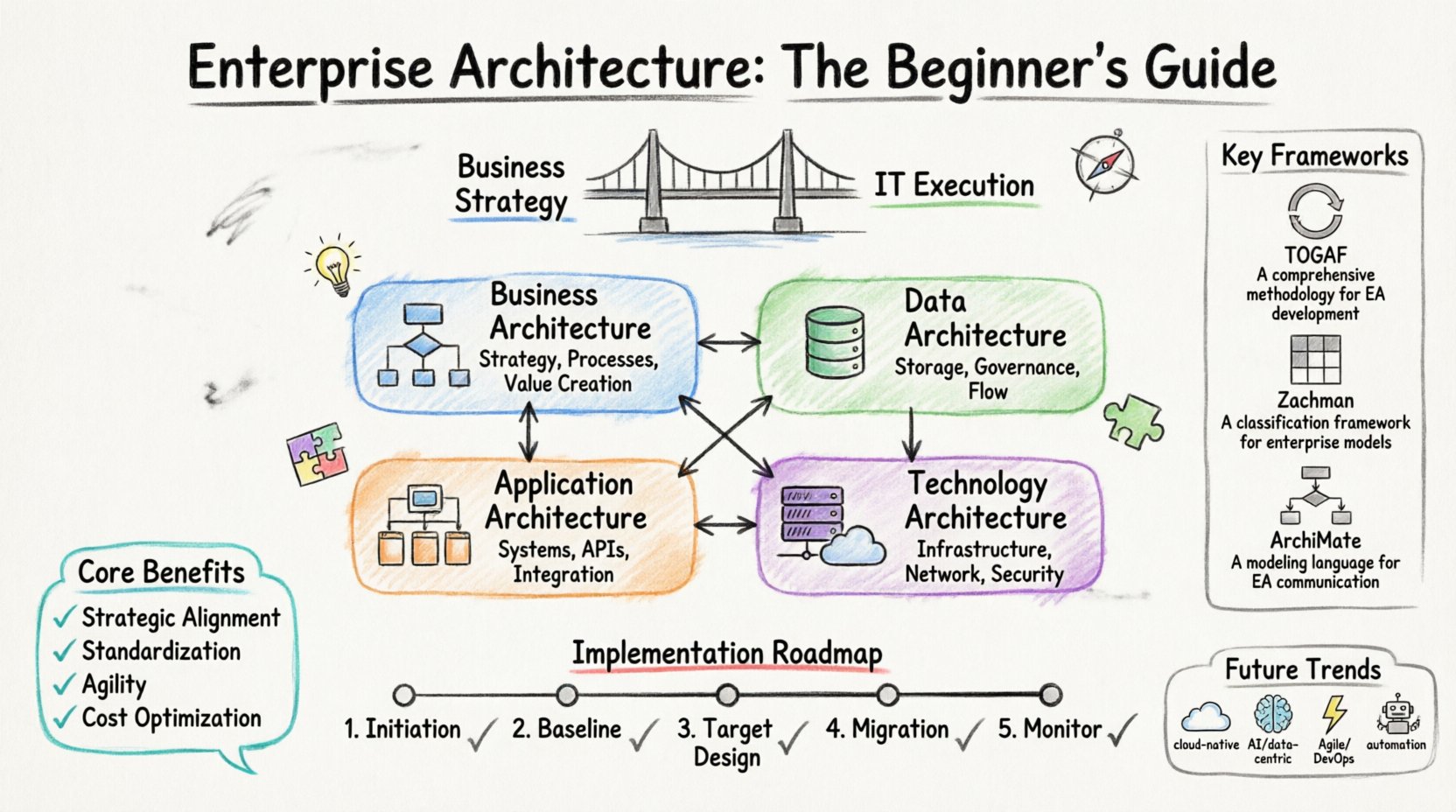
In the modern digital landscape, organizations face a complex web of technologies, business processes, and data flows. Without a cohesive plan, these elements often operate in silos, leading to inefficiency, redundancy, and strategic misalignment. This is where Enterprise Architecture (EA) steps in. It serves as the bridge connecting business strategy with IT execution.
This guide provides a comprehensive look at what Enterprise Architecture entails, the core domains it covers, and how it functions as a strategic asset for organizations of any size. Whether you are a stakeholder, a developer, or a business analyst, understanding EA is crucial for navigating complex transformations.
What is Enterprise Architecture? 🧭
Enterprise Architecture is not merely about drawing diagrams or selecting software tools. It is a discipline that aligns an organization’s business strategy with its information technology needs. It provides a holistic view of the enterprise, ensuring that every digital investment supports a specific business outcome.
- Strategic Alignment: Ensures IT projects directly support business goals.
- Standardization: Reduces complexity by establishing common standards across the organization.
- Agility: Enables faster adaptation to market changes by having a clear understanding of current capabilities.
- Cost Optimization: Identifies redundancies in systems and processes to reduce waste.
Think of EA as the blueprint for a building. Just as an architect ensures the foundation, electrical wiring, and plumbing work together before the first brick is laid, EA ensures that business units, data, applications, and infrastructure function cohesively.
The Four Core Domains of EA 🏗️
Enterprise Architecture is typically broken down into four primary domains. These domains represent the different layers of the organization that require mapping and alignment.
Each domain interacts with the others, creating a complex but interconnected ecosystem.
- Business Architecture: Describes the business strategy, governance, organization, and key business processes.
- Data Architecture: Defines how data is stored, managed, and utilized across the enterprise.
- Application Architecture: Outlines the blueprint for individual applications and their interactions.
- Technology Architecture: Describes the hardware, software, and network infrastructure required to support the applications.
| Domain | Focus Area | Key Questions |
|---|---|---|
| Business | Strategy & Operations | How do we create value? What are our processes? |
| Data | Information & Knowledge | Where does data live? Who owns it? How is it protected? |
| Application | Software Services | Which systems support our processes? How do they talk to each other? |
| Technology | Infrastructure | What servers, networks, and clouds are required? |
1. Business Architecture 🏢
This domain focuses on the business side of the equation. It includes mission statements, organizational structures, and business capabilities. It defines the capabilities the organization needs to deliver its value proposition. For example, if a company wants to offer real-time customer support, the Business Architecture defines the capability for “Real-time Support” and the processes required to enable it.
- Organizational Units
- Business Functions
- Process Flows
- Roles and Responsibilities
2. Data Architecture 🗄️
Data is often considered the most valuable asset of an enterprise. The Data Architecture ensures that data is accessible, reliable, and secure. It defines the data models, data flow, and data governance policies. In an era of analytics and AI, clean and structured data is paramount.
- Logical and Physical Data Models
- Data Standards and Metadata
- Data Security and Privacy
- Data Integration Patterns
3. Application Architecture 📱
This domain maps the individual software applications that support the business processes. It looks at the portfolio of applications, their lifecycle, and their relationships. The goal is to avoid “spaghetti architecture” where too many systems talk to each other in complex, unmanageable ways.
- Application Portfolios
- System Interfaces and APIs
- Service-Oriented Architecture (SOA)
- Cloud vs. On-Premise Application Hosting
4. Technology Architecture 🖥️
The foundation layer. This domain covers the physical and virtual infrastructure required to run the applications and store the data. It includes server hardware, networking equipment, cloud environments, and security infrastructure.
- Network Topology
- Server and Storage Infrastructure
- Cloud Services and Providers
- Security Protocols and Standards
Common Enterprise Architecture Frameworks 📐
Frameworks provide a structured approach to developing and using an architecture. They offer vocabulary, best practices, and templates to guide the process. While organizations often adapt these frameworks to their specific needs, they provide a solid starting point.
| Framework | Primary Focus | Best For |
|---|---|---|
| TOGAF | General Purpose | Large enterprises, government, diverse industries |
| Zachman | Descriptive Schema | Comprehensive inventory and classification |
| FEAF | Government | Public sector agencies |
| ArchiMate | Modeling Language | Visualizing and documenting architectures |
TOGAF (The Open Group Architecture Framework)
TOGAF is one of the most widely used frameworks globally. It centers on the Architecture Development Method (ADM), a step-by-step approach to developing an architecture. It is iterative and cyclical, allowing for continuous improvement. The core of TOGAF is the Architecture Content Framework, which defines what artifacts are produced.
Zachman Framework
The Zachman Framework is not a process but an ontology. It is a schema for organizing architectural artifacts. It is structured as a matrix with six perspectives (What, How, Where, Who, When, Why) and six levels of abstraction (Planner, Owner, Designer, Builder, Subcontractor, User). It ensures that every aspect of the architecture is documented from every necessary viewpoint.
ArchiMate
ArchiMate is a modeling language that provides a uniform way to describe, analyze, and visualize business and IT architectures. It allows architects to create clear diagrams that show the relationships between the business, application, and technology layers. It is often used in conjunction with TOGAF.
Key Stakeholders and Governance 🤝
Enterprise Architecture is a collaborative effort. Success depends on engaging the right people and establishing clear governance mechanisms. Without executive support, EA initiatives often stall.
- Chief Information Officer (CIO): Typically sponsors the EA function and ensures IT aligns with business strategy.
- Enterprise Architects: The practitioners who design and document the architecture.
- Business Leaders: Provide the strategic direction and requirements.
- Developers & Engineers: Implement the architecture and provide feedback on feasibility.
- Security Officers: Ensure compliance and security standards are met.
Establishing Governance
Governance ensures that the architecture is actually followed. It involves decision-making bodies that review projects to ensure they adhere to the defined standards.
- Architecture Review Boards (ARB): Groups that review new projects against architectural standards.
- Standards: Clear rules on technology choices, coding standards, and data formats.
- Compliance: Monitoring to ensure adherence to policies and regulations.
Implementing Enterprise Architecture 🚀
Starting an EA program can seem daunting. It requires a phased approach to ensure value is delivered quickly while building long-term capabilities. Here is a typical roadmap for implementation.
Phase 1: Initiation and Scope
Define the scope of the architecture. Is it for the entire enterprise or a specific division? Identify the key stakeholders and secure their commitment. Define the goals, such as cost reduction or improved agility.
Phase 2: Baseline Assessment
Understand the current state. Document existing processes, systems, and data flows. Identify gaps between the current state and the desired future state. This often involves surveys, interviews, and discovery workshops.
Phase 3: Target Architecture Design
Design the future state. This involves defining the ideal business, data, application, and technology architectures. It should reflect the strategic goals identified in Phase 1.
Phase 4: Migration Planning
Create a roadmap for moving from the baseline to the target. This includes prioritizing projects, estimating costs, and scheduling timelines. It is crucial to identify quick wins that demonstrate value early.
Phase 5: Implementation and Monitoring
Execute the migration plan. Monitor progress against the roadmap. Update the architecture as the environment changes. EA is not a one-time project; it is a continuous cycle.
Common Challenges and Pitfalls ⚠️
Even with a solid plan, Enterprise Architecture initiatives face significant hurdles. Recognizing these challenges early can help mitigate risks.
- Lack of Executive Support: Without top-level backing, architects struggle to enforce standards or influence decisions.
- Over-Engineering: Creating overly complex models that are difficult to maintain or understand.
- Resistance to Change: Business units may resist new standards if they perceive them as bureaucratic hurdles.
- Outdated Information: If the architecture repository is not maintained, it becomes obsolete quickly.
- Disconnect from Reality: Architects who do not understand the technical constraints or business realities may design unimplementable solutions.
The Future of Enterprise Architecture 🔮
As technology evolves, so does the discipline of Enterprise Architecture. Several trends are shaping the future of EA.
Cloud-Native Architectures
Organizations are moving away from monolithic structures to cloud-native, microservices-based architectures. This requires a shift in focus from infrastructure to service orchestration and API management.
Data-Centricity
With the rise of AI and machine learning, data architecture is becoming as critical as business architecture. The ability to manage data governance, lineage, and quality is becoming a primary EA responsibility.
Agility and DevOps Integration
Traditional EA was often seen as slow and bureaucratic. Modern EA is integrating with Agile and DevOps practices, allowing for continuous architecture validation rather than periodic reviews.
Automation
Tools are increasingly automating the discovery of existing systems and the generation of architecture models. This reduces the manual burden on architects and keeps the architecture current.
Frequently Asked Questions ❓
Is Enterprise Architecture only for large companies?
No. While large enterprises have more complex systems, small and medium businesses also benefit from EA. It helps them avoid costly mistakes, plan for growth, and manage technical debt effectively.
How does EA differ from IT Strategy?
IT Strategy focuses on the high-level goals and direction of the IT function. EA provides the detailed blueprint and standards to achieve those goals. IT Strategy is the “what” and “why”; EA is the “how” and “where”.
How long does it take to implement EA?
There is no fixed timeline. It depends on the size of the organization and the scope of the initial engagement. However, a phased approach allows for value realization within months rather than years.
Do I need to buy specific software for EA?
No. While there are tools available to manage architecture repositories and models, the core of EA is the thinking and the process. Many organizations start with spreadsheets and standard modeling tools before investing in specialized software.
What is the role of an Enterprise Architect?
An Enterprise Architect acts as a translator between business and technology. They ensure that technology investments deliver business value, manage technical risk, and drive innovation. They must possess both technical knowledge and business acumen.
Conclusion 💡
Enterprise Architecture is a critical discipline for organizations aiming to thrive in a complex digital environment. It provides the structure needed to align technology investments with business objectives, ensuring that every dollar spent contributes to strategic goals.
By understanding the core domains, leveraging established frameworks, and navigating the challenges of implementation, organizations can build a resilient and agile foundation. The journey is ongoing, requiring constant adaptation and collaboration. With a clear vision and disciplined approach, Enterprise Architecture transforms from a theoretical concept into a tangible driver of success.