


Enterprise architecture frameworks often struggle to bridge the gap between high-level business strategy and low-level technical implementation. Microservices architecture represents a significant shift in how software is constructed, moving away from monolithic structures to distributed, loosely coupled services. When applying the ArchiMate modeling language to this context, architects must carefully select concepts that accurately reflect the dynamic nature of these systems. This guide explores the systematic approach to representing microservices patterns within the ArchiMate framework.
By aligning ArchiMate layers with microservice characteristics, organizations can achieve clarity in their technical debt, dependency management, and infrastructure planning. This document provides a detailed breakdown of structural elements, relationships, and specific patterns, ensuring that the resulting models serve as actionable blueprints rather than abstract diagrams.
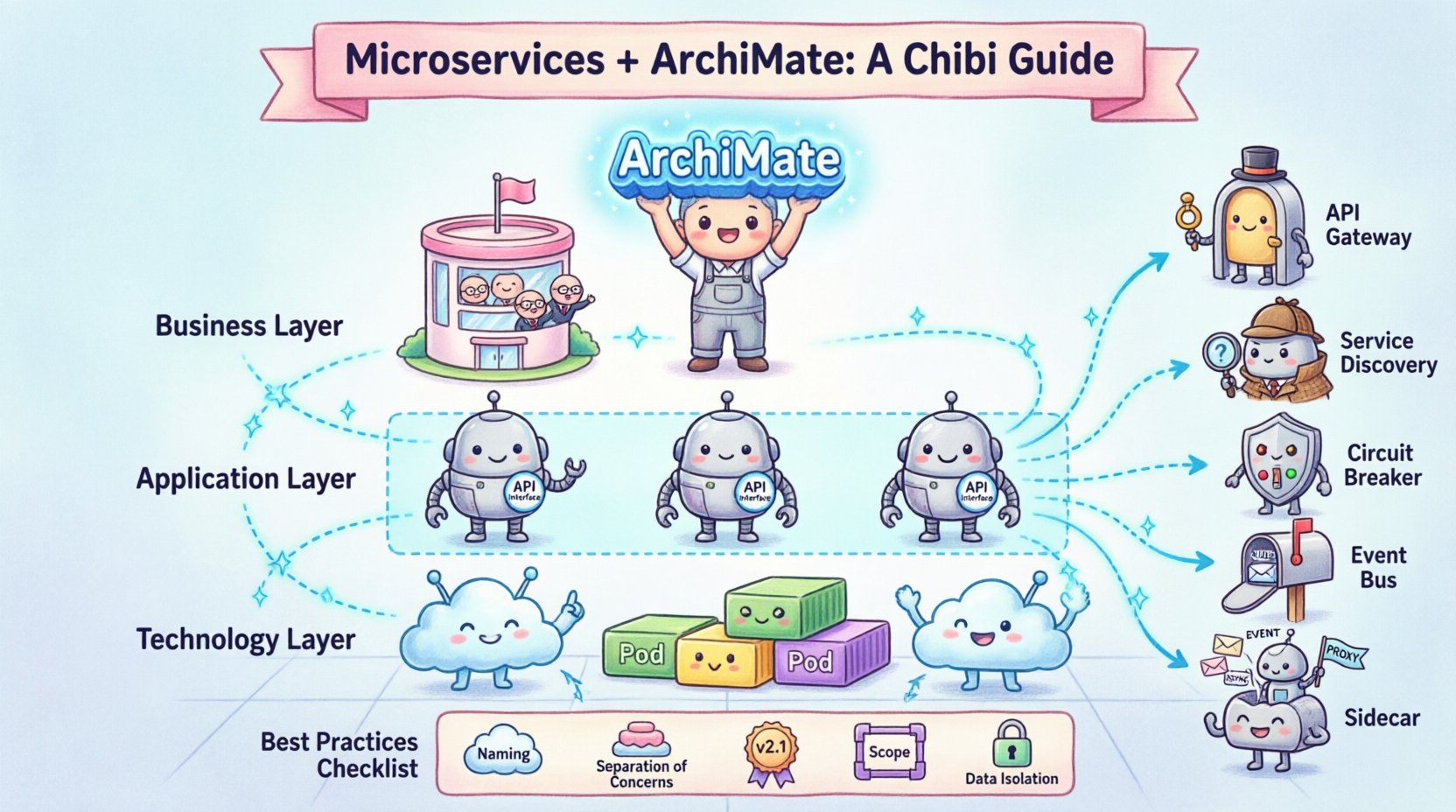
🔍 Understanding the ArchiMate Layers for Microservices
ArchiMate organizes enterprise architecture into distinct layers: Business, Application, and Technology. Microservices span primarily across the Application and Technology layers, though their impact resonates into Business services. Understanding where each microservice component resides is the first step in accurate modeling.
- Business Layer: Represents the services delivered to customers or internal stakeholders. Microservices often expose functionality that maps to business capabilities.
- Application Layer: This is the core domain for microservices. Individual services are modeled as Application Components. They interact via Application Interfaces.
- Technology Layer: Physical infrastructure, nodes, and devices. Microservices run on containers or virtual machines, which are modeled as Technology Nodes or Devices.
When modeling a distributed system, it is crucial to maintain the separation of concerns. A single microservice might be an Application Component in the Application Layer, but it relies on a specific Technology Node in the Technology Layer. This separation allows architects to visualize deployment issues without confusing business logic with physical hardware.
🧱 Mapping Structural Elements
To model microservices effectively, one must map architectural primitives to ArchiMate elements. The following table outlines the standard mapping strategy used in enterprise architecture.
| Microservice Concept | ArchiMate Element | Usage Context |
|---|---|---|
| Microservice Instance | Application Component | Encapsulates business functionality and logic |
| API Endpoint | Application Interface | Defines the contract for communication |
| Service Registry | Application Service / Function | Provides discovery and registration logic |
| Container / Pod | Technology Node | Represents the runtime environment |
| Data Store | Data Object / Storage | Persistent storage for service state |
| Load Balancer | Application Component | Distributes traffic across instances |
Using these mappings ensures consistency across the architecture model. For instance, when a business process requires a specific data transaction, the flow should trace from a Business Process, through a Business Service, down to the Application Component that executes the transaction. This vertical traceability is a key strength of the ArchiMate language.
🛠️ Modeling Specific Microservice Patterns
Microservices are rarely isolated; they follow established patterns to handle complexity, resilience, and communication. Below are the most common patterns and how to represent them structurally.
1. API Gateway Pattern 🚪
The API Gateway acts as the single entry point for all client requests. It routes, composes, and orchestrates calls to backend services. In ArchiMate, this is modeled as a central Application Component.
- Structure: Create an Application Component named “API Gateway”.
- Interfaces: Define Application Interfaces for external clients (e.g., “REST API”) and internal services (e.g., “Internal Protocol”).
- Relationships: Use the Access relationship to show clients accessing the Gateway. Use the Communication relationship to show the Gateway communicating with downstream Application Components.
- Business Value: This pattern abstracts the complexity of the backend from the frontend, a critical capability for user experience design.
2. Service Discovery Pattern 🔍
In dynamic environments, service instances change IP addresses and ports. A Service Discovery mechanism allows clients to locate available services without hardcoding network details.
- Structure: Model the Service Registry as an Application Component or an Application Service.
- Relationships: Services Register with the Registry. Clients Access the Registry to find endpoints.
- Modeling Nuance: Ensure the Registration process is shown as a Business Process or Application Function to capture the lifecycle event.
3. Circuit Breaker Pattern 🛑
This pattern prevents a network or service failure from cascading to other parts of the system. It stops the system from repeatedly trying to execute an operation that is likely to fail.
- Structure: Model the Circuit Breaker as an Application Component associated with the specific service.
- Behavior: Use Triggering relationships to show state changes (Closed, Open, Half-Open) based on failure rates.
- Dependency: Show the dependency between the Circuit Breaker and the target service. If the service fails, the Circuit Breaker opens.
4. Event Bus Pattern 📢
Services often need to communicate asynchronously. An Event Bus facilitates decoupled communication where publishers do not need to know about subscribers.
- Structure: Model the Event Bus as an Application Component or a Technology Node depending on the implementation level.
- Relationships: Use Communication relationships between services and the Event Bus. Services Publish events and Subscribe to events.
- Modeling Nuance: Represent events as Data Objects. This clarifies the payload structure and data ownership.
5. Sidecar Pattern 🚀
A sidecar is a helper process that runs alongside the main application container. It handles cross-cutting concerns like logging, monitoring, or proxying.
- Structure: Model the main service as an Application Component. Model the sidecar as a separate Application Component.
- Deployment: Both components reside on the same Technology Node.
- Relationships: Use Communication to show local interaction. Use Realization if the sidecar implements a specific interface required by the main service.
🔗 Defining Relationships and Dynamics
Static structure is not enough. Microservices are defined by how they interact. ArchiMate provides specific relationship types to capture these dynamics accurately.
Communication vs. Access
- Communication: Use this for data flow between Application Components. It implies a direct exchange of messages, such as a REST call or a message queue transfer.
- Access: Use this when one service uses the functionality of another as a service. For example, a Frontend Application Accesses the API Gateway.
Dependency and Association
- Dependency: Indicates that a component relies on another for its existence or function. If the target is removed, the source fails.
- Association: A looser link, often used for business relationships or non-functional constraints.
Triggering
Microservices often react to events. The Triggering relationship is vital here. It shows that the occurrence of a process or function in one component initiates a process in another. This is essential for modeling event-driven architectures.
📊 Best Practices for Architecture Modeling
To maintain a high-quality architecture model, adhere to these guidelines. Consistency ensures that the model remains useful over time.
- Standardize Naming Conventions: Ensure all Application Components follow a consistent naming scheme (e.g., “svc-order-processing”). This reduces ambiguity in large diagrams.
- Layer Consistency: Do not mix layers. Do not place a Technology Node directly in the Application Layer. Keep the layers distinct to preserve abstraction.
- Versioning: Use attributes or separate layers to indicate versions of interfaces. Microservices evolve rapidly; the model must reflect this without becoming cluttered.
- Scope Management: Avoid modeling every single microservice in one diagram. Use views and viewpoints to focus on specific concerns (e.g., Data Flow View vs. Deployment View).
- Data Ownership: Clearly define which Application Component owns which Data Object. This prevents the “shared database” anti-pattern from becoming a hidden reality in the model.
🛡️ Challenges and Considerations
Modeling microservices introduces complexity that monolithic models did not require. Architects must anticipate these challenges.
Scale and Complexity
As the number of services grows, the diagram can become unreadable. Use grouping mechanisms to cluster related services. For example, group all “Order Management” services together. This visual hierarchy aids comprehension.
Network Topology
The Technology Layer becomes critical. Network segmentation, firewalls, and security groups affect communication. Model these constraints using Technology Services and Nodes. This helps security architects identify gaps in the defense-in-depth strategy.
State Management
Microservices are often stateless, but they interact with stateful data stores. Model the Data Objects explicitly. Differentiate between transient data and persistent data. This distinction influences the choice of storage mechanisms in the Technology Layer.
Consistency Models
Distributed systems struggle with consistency. While the model does not solve the CAP theorem, it can highlight where strong consistency is required versus where eventual consistency is acceptable. Use Assignment relationships to link processes to consistency requirements.
🔄 Integration with Business Capabilities
The ultimate goal of architecture modeling is to align technology with business goals. Microservices should map directly to business capabilities.
- Capability Mapping: Link an Application Component to a Business Capability. This shows which business function is supported by which technical service.
- Process Alignment: Ensure that Business Processes trigger the appropriate Application Functions. If a business process steps on a technical service, the model should reflect this.
- Gap Analysis: Use the model to identify capabilities that lack technical support. If a Business Capability has no Application Component linked, it is a gap that needs addressing.
This alignment ensures that technical decisions are not made in a vacuum. Every microservice should have a business justification. If a service does not contribute to a capability or process, it may be a candidate for removal or consolidation.
📝 Summary of Modeling Considerations
Implementing microservices requires a structured approach to architecture documentation. ArchiMate provides the necessary vocabulary to describe these systems without getting lost in implementation details.
- Use Application Components for service logic.
- Use Technology Nodes for infrastructure.
- Map APIs to Application Interfaces.
- Utilize Communication and Triggering relationships for flow.
- Group related services to manage visual complexity.
- Maintain strict layer separation to preserve abstraction.
By following these patterns and guidelines, architects can create models that are both technically accurate and business-relevant. These models serve as a single source of truth, facilitating communication between development teams, operations, and business stakeholders. The result is an architecture that is resilient, scalable, and aligned with organizational strategy.