

Enterprise Architecture often struggles with the disconnect between high-level business strategy and the technical details that support it. One of the most critical challenges involves ensuring that every technical capability or change can be directly linked back to a specific business need. The ArchiMate framework provides a robust method for this alignment through its Motivation Viewpoint. By tracing business requirements to the Motivation View, architects create a clear line of sight from strategic intent to implementation. This process ensures that resources are not wasted on features that do not serve a defined purpose.
This guide explores the mechanics of mapping requirements within the ArchiMate Motivation View. It focuses on the logical flow of information, the relationships between elements, and the practical steps required to maintain traceability. Understanding this connection is vital for governance, compliance, and effective change management.
Understanding the Motivation Viewpoint 🧠
The Motivation Viewpoint is designed to capture the drivers and motivations behind business decisions. It sits at the top of the architectural stack, influencing the Strategy, Business, Application, and Technology layers below. Unlike other viewpoints that focus on structure or behavior, the Motivation View focuses on why things are being done. It answers questions regarding value, necessity, and obligation.
When tracing requirements, the Motivation View acts as the anchor. Without this anchor, technical specifications can drift away from business value. The view consists of specific elements that represent the intent of the organization.
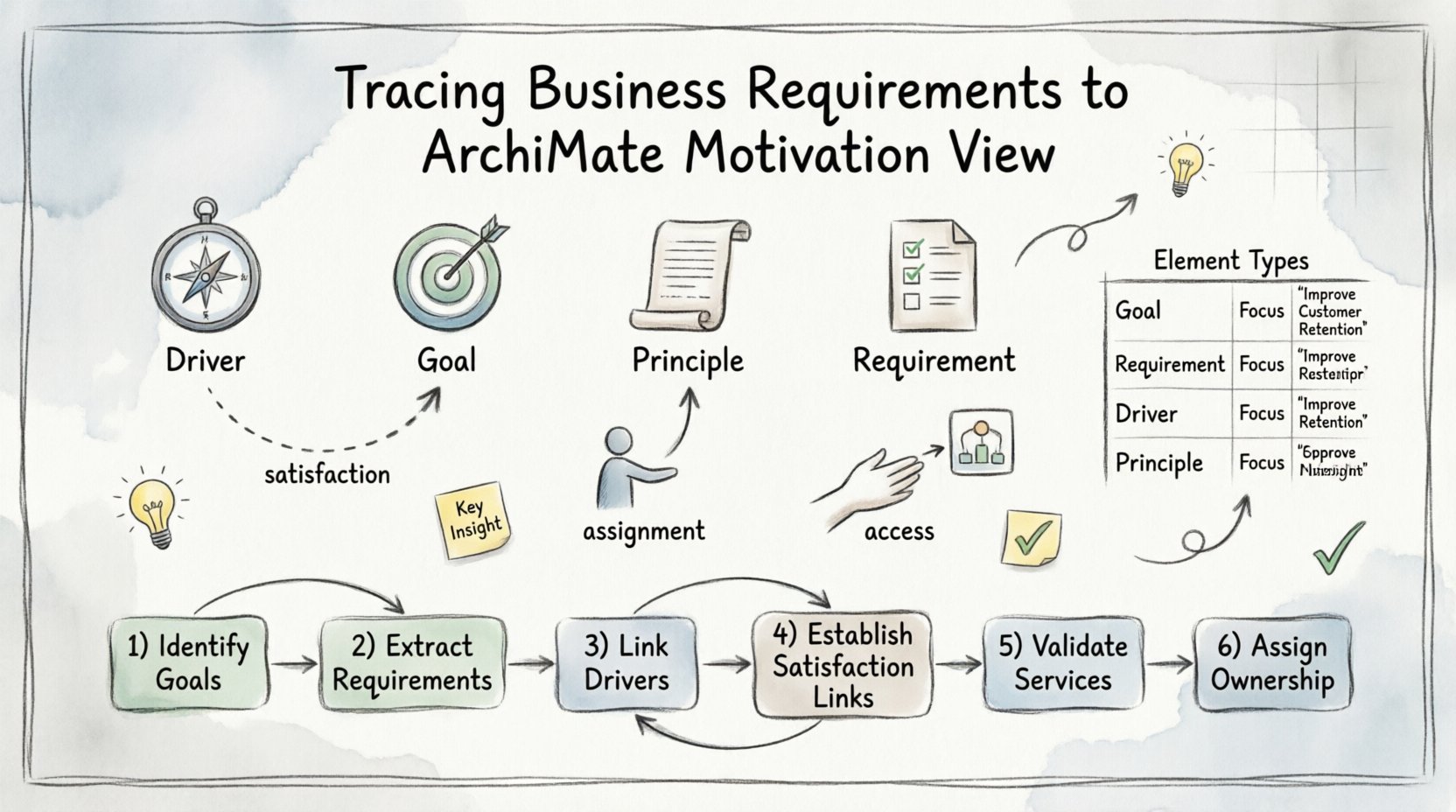
- Goal: A specific outcome that an organization aims to achieve. Goals are often high-level and strategic.
- Requirement: A condition or capability that must be met or possessed to satisfy a stakeholder or achieve an objective.
- Driver: A factor that causes an entity to take action or change its state. Drivers are often external or internal pressures.
- Principle: A general rule or guideline for decision making that supports the achievement of a goal.
- Assessment: An evaluation of the current state against a requirement or goal.
These elements form the vocabulary of the Motivation View. Tracing business requirements involves linking these elements to the more concrete elements found in the Business, Application, or Technology layers.
Core Elements in ArchiMate Motivation 📋
To effectively trace requirements, one must understand the nature of the elements involved. Each element type serves a distinct purpose in the architecture model. Confusing these types can lead to a broken traceability chain.
1. Goals and Objectives
Goals represent the desired end state. They are often derived from the business strategy. In a tracing context, a Goal is the parent element that a Requirement must support. If a Goal is defined as “Reduce Operational Costs by 15%”, any Requirement tracing to it must contribute to that specific reduction.
2. Requirements and Constraints
Requirements specify what the system or process must do. They are the bridge between the abstract Goal and the concrete Solution. Requirements can be functional (what the system does) or non-functional (how the system behaves, such as performance or security).
3. Drivers and Obligations
Drivers explain the force behind a Requirement. A Driver might be a regulatory change, a market shift, or a technological advancement. Obligations are similar but often imply a mandatory action rather than a voluntary initiative.
| Element Type | Focus | Example |
|---|---|---|
| Goal | Outcome | Increase Customer Satisfaction |
| Requirement | Condition | Support 24/7 Availability |
| Driver | Reason | New Compliance Regulation |
| Principle | Rule | Data Privacy First |
Mapping Relationships 🔗
The power of the ArchiMate Motivation View lies in the relationships between elements. These relationships define the flow of influence and satisfaction. When tracing requirements, you are essentially navigating these relationships to prove value.
Satisfaction Relationship
The satisfaction relationship connects a Requirement to a Goal. It indicates that satisfying the requirement contributes to achieving the goal. This is the primary relationship for tracing business requirements upward.
- Direction: From Requirement to Goal.
- Meaning: If the requirement is met, the goal is moved closer to completion.
Assignment Relationship
The assignment relationship connects an actor or organization to a motivation element. It clarifies who is responsible for driving or satisfying the requirement.
- Direction: From Actor to Motivation Element.
- Meaning: The actor is accountable for the element.
Access Relationship
The access relationship connects a Motivation element to an Application or Business Service. It implies that the requirement necessitates the use of a specific service.
Triggering Relationship
The triggering relationship connects an Event to a Business Process or Function. While less common in pure motivation tracing, it links the when to the what.
The Mapping Process 🛠️
Tracing business requirements to the Motivation View is not a one-time activity. It is a continuous process that evolves as the architecture changes. The following steps outline a logical approach to establishing and maintaining these traces.
Step 1: Identify Strategic Goals
Begin by cataloging the high-level goals of the organization. These should be documented clearly. Ensure they are measurable where possible. For example, instead of “Improve Efficiency”, use “Reduce Transaction Processing Time by 20%”.
Step 2: Extract Business Requirements
Gather the requirements from stakeholders. These often come from business analysis documents, user stories, or regulatory compliance lists. Group them by theme to avoid fragmentation.
Step 3: Link Requirements to Drivers
Before linking to goals, understand why the requirement exists. Is it driven by a market shift? A legal obligation? A technological opportunity? Assign a Driver element to each requirement. This adds context and justification to the model.
Step 4: Establish Satisfaction Links
Connect each Requirement to the relevant Goal using the satisfaction relationship. A single requirement might satisfy multiple goals. Conversely, a single goal might require multiple requirements. Ensure the connections are explicit and documented.
Step 5: Validate Against Business Services
Once the motivation elements are in place, trace them down to the Business Services layer. Use the access relationship to show which services deliver the value required by the motivation elements. This creates a complete chain from Goal to Service.
Step 6: Assign Ownership
Use the assignment relationship to designate responsibility. This ensures that for every requirement, there is an accountable actor. This is critical for governance and auditing.
Managing Requirements and Goals 🎯
Maintaining the integrity of the Motivation View requires discipline. As the enterprise evolves, goals change, and requirements shift. Without proper management, the model becomes outdated and loses its value.
- Version Control: Keep track of changes to goals and requirements. Document the date of the change and the reason for the update.
- Dependency Analysis: Regularly review dependencies between requirements. If a critical requirement is removed, understand which goals are no longer being satisfied.
- Impact Assessment: When a goal is modified, assess the impact on all linked requirements. This helps in prioritizing development efforts.
- Stakeholder Review: Periodically review the model with business stakeholders. Ensure the motivation elements still reflect reality.
Common Challenges and Solutions ⚠️
Implementing this tracing process often encounters hurdles. Recognizing these early allows for better planning and mitigation.
Challenge 1: Over-Complication
Architects sometimes create too many elements or relationships. This leads to a “spaghetti model” that is difficult to navigate.
- Solution: Enforce a minimum viable model. Only create elements that are necessary for decision-making. Aggregate similar requirements where possible.
Challenge 2: Orphaned Elements
Elements that have no connections to other parts of the architecture provide no value.
- Solution: Run regular queries or reports to find elements with zero incoming or outgoing relationships. Review them to determine if they should be deleted or connected.
Challenge 3: Ambiguous Requirements
Requirements that are vague make tracing impossible. If a requirement is not clear, it cannot be linked to a specific goal.
- Solution: Implement a review process for requirement definitions before they enter the model. Ensure they are SMART (Specific, Measurable, Achievable, Relevant, Time-bound).
Challenge 4: Maintenance Burden
Keeping the model up to date is labor-intensive.
- Solution: Automate where possible. Use reporting tools to highlight gaps in the traceability chain. Integrate the architecture repository with project management tools to capture requirement changes automatically.
Ensuring Traceability and Governance ✅
Traceability is not just about drawing lines in a diagram. It is about governance. It ensures that every line of code or every process change has a business justification. This is particularly important for compliance audits and risk management.
When an auditor asks, “Why are we investing in this specific application feature?”, the Motivation View provides the answer. It shows the link from the feature to the business service, to the requirement, to the driver, and finally to the strategic goal.
Effective governance also involves defining rules for the model. For instance, a rule might state that no Requirement can exist without an associated Driver. Another rule might state that every Goal must have at least one satisfied Requirement. These rules help maintain the quality of the architecture.
Integrating with Other Viewpoints 🔄
The Motivation View does not exist in isolation. It interacts with the Strategy, Business, Application, and Technology views. The integrity of the entire architecture depends on these cross-viewpoint connections.
Connection to Strategy View
The Motivation View often overlaps with the Strategy View. While the Strategy View focuses on the structure of the strategy (Market, Business Unit, etc.), the Motivation View focuses on the intent (Goals, Principles). Combining them provides a complete picture of strategic intent.
Connection to Business View
The Business View details the processes, roles, and objects. Tracing requirements to the Motivation View ensures that Business Processes are built to satisfy specific Goals. If a Business Process does not trace back to a Goal, it may be a candidate for elimination.
Connection to Application View
The Application View describes the software systems. By linking requirements to applications, architects can justify software investments. If an application does not satisfy any active requirements, it represents a potential cost-saving opportunity.
Connection to Technology View
The Technology View covers infrastructure. Similarly, infrastructure requirements should trace back to business needs. This prevents “gold-plating” infrastructure that exceeds business requirements.
Best Practices for Implementation 🚀
To maximize the value of this approach, adhere to these best practices.
- Standardize Naming Conventions: Use consistent naming for Goals and Requirements. This makes searching and reporting easier.
- Define Relationship Semantics: Ensure all stakeholders understand what “satisfaction” means in your context. Does it mean partial or full satisfaction?
- Use Hierarchical Grouping: Group related requirements together to reduce clutter. Use composition relationships where appropriate.
- Regular Audits: Schedule quarterly reviews of the Motivation View to ensure it remains current.
- Visual Clarity: Use diagrams to visualize the traces. A list of relationships is hard to understand visually. A graph shows the density and gaps clearly.
Final Considerations 💡
Tracing business requirements to the ArchiMate Motivation View is a foundational practice for mature Enterprise Architecture. It transforms architecture from a technical exercise into a strategic asset. By maintaining clear links between what the business wants (Goals) and what the system does (Requirements), organizations can make better decisions.
The effort required to build and maintain this view is an investment. It pays dividends in reduced waste, improved compliance, and clearer communication between business and IT leaders. As the enterprise evolves, the Motivation View serves as a compass, guiding change in the direction of true value.
Start by documenting your core goals and requirements. Establish the satisfaction relationships. Then, expand outward to cover your services and systems. Over time, this traceability will become an integral part of your organizational culture.