


In the complex landscape of enterprise architecture, aligning high-level strategy with execution remains a persistent challenge. Organizations often struggle to translate abstract visions into tangible actions. The ArchiMate framework provides a structured approach to this problem through its Motivation Layer. This layer serves as the foundational bridge between business drivers and the technical implementation details.
Understanding how to map strategic goals using ArchiMate motivation elements is essential for architects who want to ensure that every technical decision supports the broader business intent. This guide explores the mechanics of the Motivation Layer, the specific elements available, and the methodologies for connecting strategy to architecture without relying on proprietary tools or jargon.
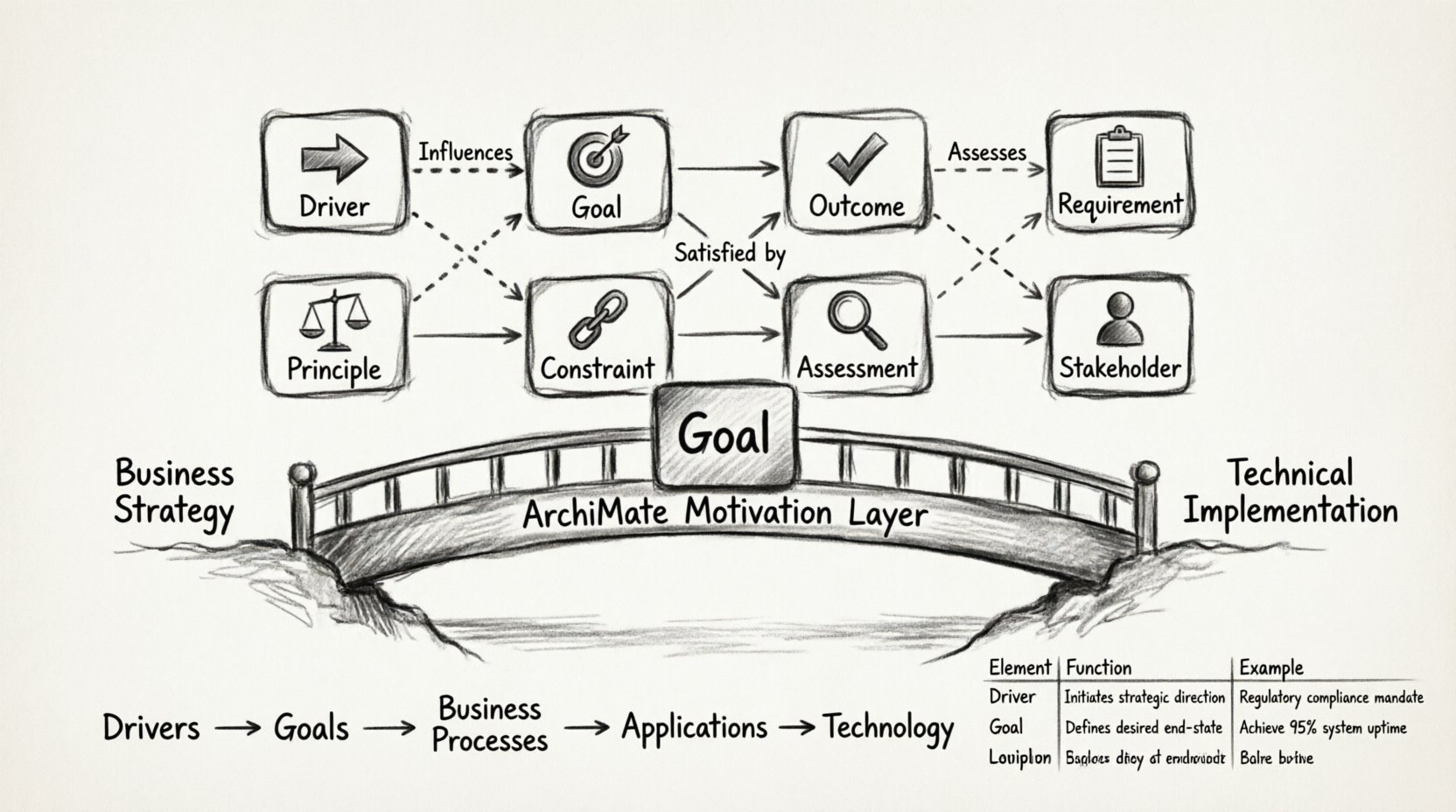
Understanding the Motivation Layer in ArchiMate 🏗️
The Motivation Layer is distinct from the core layers like Business, Application, and Technology. While those layers describe the state of the enterprise, the Motivation Layer explains the why. It captures the internal and external factors that drive change and the outcomes the organization seeks to achieve.
Without this layer, an architecture model becomes a static snapshot of the current state. With it, the model becomes a dynamic representation of intent. It allows stakeholders to trace a path from a high-level business goal down to a specific technology component, verifying that the architecture is purposeful.
Why Strategic Alignment Matters
- Clarity: It removes ambiguity regarding which initiatives are critical.
- Traceability: It enables backtracking from technical debt to business drivers.
- Decision Making: It provides context for prioritizing projects based on impact.
- Communication: It offers a common language for IT and business leaders.
When mapping goals, the focus is not merely on listing objectives. It is about establishing relationships. A goal might be satisfied by an outcome. An outcome might be achieved through a business process. This chain of reasoning is what gives the architecture its value.
Core Elements of the Motivation Layer 🧩
ArchiMate defines eight specific elements within the Motivation Layer. Each serves a unique function in the modeling process. To map strategic goals effectively, one must understand the precise definition and application of each element.
1. Goal
A goal represents a specific objective that an organization wishes to achieve. It is the target state. Goals are often derived from business strategy or regulatory requirements. In the context of mapping, goals are the anchors. They define what success looks like.
Characteristics:
- Can be abstract or concrete.
- Can be satisfied or not satisfied.
- Often linked to value drivers.
2. Outcome
An outcome is the result of an activity or process. It represents the tangible or intangible benefit that arises from achieving a goal. Outcomes are often used to measure the success of a goal.
Example: If the goal is “Reduce Operational Costs,” the outcome might be “10% Reduction in Monthly Spend.”
3. Requirement
A requirement specifies a condition that must be met. It is often a constraint or a need that the architecture must address. Requirements can stem from regulations, security policies, or stakeholder demands.
Usage: Requirements act as guardrails. They ensure that the solution remains compliant and viable.
4. Assessment
An assessment is a judgment made about the state of an element. It evaluates whether a goal is met or a requirement is satisfied. Assessments provide the feedback loop necessary for continuous improvement.
Function: It answers the question, “Are we there yet?”
5. Driver
A driver is a factor that influences the motivation of an entity. It is the external or internal force that pushes the organization toward change. Drivers are often the starting point of strategic planning.
Types:
- Internal: Market pressure, financial targets.
- External: New legislation, competitor activity.
6. Principle
A principle is a rule or guideline that governs the behavior of the enterprise. Principles are high-level directives that shape decision-making. They are less specific than requirements but more binding than goals.
Role: They provide consistency across different projects and domains.
7. Constraint
A constraint is a restriction on the design or implementation of the architecture. It limits the choices available to architects. Constraints are often hard limits, such as budget caps or technology compatibility issues.
8. Stakeholder
A stakeholder is an individual or group with an interest in the architecture. While not a motivation element in the strictest sense of “force,” stakeholders are the owners of the motivation. They hold the goals and define the drivers.
Mapping Relationships Between Elements 🔗
Mapping strategic goals is not about placing icons on a canvas. It is about defining the relationships between them. ArchiMate provides specific relationship types that dictate how these elements interact. Understanding these relationships is critical for accurate modeling.
Goal Satisfaction
The most common relationship in the Motivation Layer is satisfaction. A goal is satisfied by another goal, an outcome, or a requirement. This relationship indicates that achieving the latter helps achieve the former.
Example:
- Goal: Improve Customer Experience.
- Goal: Reduce Wait Times.
- Relationship: The “Reduce Wait Times” goal satisfies the “Improve Customer Experience” goal.
Assessment of Motivation
Assessments are linked to the elements they evaluate. A stakeholder assesses a goal. A requirement assesses a constraint. This relationship allows for the tracking of status over time.
Driver Influence
Drivers influence goals, requirements, and principles. A change in a driver often necessitates a change in the architecture. Mapping this influence helps architects anticipate change.
Example: A new data privacy regulation (Driver) influences the requirement for data encryption (Requirement).
Practical Guide to Mapping Strategic Goals 📝
Executing a mapping exercise requires a disciplined approach. The following steps outline a methodical process for integrating motivation elements into an architecture model.
Step 1: Identify Business Drivers
Begin by gathering information on what is driving the organization. Conduct interviews with leadership to understand market pressures, internal inefficiencies, or growth targets. Document these as Drivers.
- Ask: What forces are pushing us to change?
- Ask: What external factors impact our strategy?
Step 2: Define Strategic Goals
Translate the drivers into specific goals. Goals should be measurable and time-bound. Avoid vague statements. Ensure each goal has a clear owner or stakeholder.
- Ensure goals are aligned with the drivers.
- Ensure goals do not contradict one another.
Step 3: Establish Requirements and Principles
Define the boundaries within which the goals must be achieved. Identify principles that will guide the design. Capture requirements that must be met for the goals to be valid.
Step 4: Link to Business and Technology Layers
Connect the motivation elements to the Business Layer. Map goals to business processes, functions, and actors. This ensures that the strategy is grounded in operational reality. Subsequently, link business capabilities to Application and Technology layers.
Step 5: Validate with Stakeholders
Review the model with the stakeholders identified in Step 1. Ensure their assessment of the goals matches the model. This step validates the accuracy of the mapping.
Table: Motivation Element Functions and Relationships
| Element | Primary Function | Common Relationships | Example |
|---|---|---|---|
| Goal | Define target state | Satisfied by, Influenced by | “Increase Revenue by 10%” |
| Outcome | Measure achievement | Satisfied by | “10% Revenue Growth” |
| Driver | Explain cause of change | Influences, Assessed by | “New Competitor Entry” |
| Requirement | Specify conditions | Satisfied by, Influenced by | “Compliance with GDPR” |
| Assessment | Evaluate state | Assesses | “Goal Status: On Track” |
| Principle | Set rules | Influences | “Cloud First Policy” |
| Constraint | Limit options | Restricts | “Budget Cap $50k” |
| Stakeholder | Own the intent | Assesses, Influences | “Chief Financial Officer” |
Integrating Motivation with Other Layers 🔄
The true power of ArchiMate lies in its layered approach. The Motivation Layer does not exist in isolation. It must be connected to the Business, Application, and Technology layers to form a complete picture.
Motivation to Business
Strategic goals must drive business processes. If a goal is “Improve Efficiency,” there must be a corresponding business process that is optimized. The mapping here ensures that the architecture supports the workflow.
- Map goals to business functions.
- Link drivers to business actors.
Business to Application
Once the business needs are defined, the application layer provides the software support. Requirements in the Motivation layer often dictate the functional requirements of applications.
Application to Technology
Finally, the technology layer hosts the applications. Constraints in the Motivation layer often limit the choice of technology. For instance, a constraint regarding cost might limit the selection of cloud providers.
Common Challenges in Motivation Modeling ⚠️
While the framework is robust, practical application often encounters difficulties. Recognizing these challenges early can prevent modeling errors.
1. Over-Modeling
Architects sometimes create too many elements, making the model complex and difficult to maintain. Focus on the critical goals that drive change. Ignore minor details that do not impact the strategic direction.
2. Lack of Traceability
If the connection between a driver and a technology component is broken, the model loses value. Ensure that every link in the chain is documented. A goal should never float without a supporting requirement or process.
3. Stale Data
Strategies change. If the motivation layer is not updated regularly, it becomes a historical record rather than a planning tool. Establish a review cadence to update assessments and goals.
4. Ambiguity
Terms like “Efficiency” or “Growth” are subjective. Define them clearly within the model. Use specific metrics for goals and outcomes to avoid misinterpretation.
Best Practices for Maintenance 🛠️
Once the model is created, it requires care. The following practices ensure the longevity and utility of the motivation mapping.
- Regular Reviews: Schedule quarterly reviews with leadership to update goals and drivers.
- Change Management: When a strategic driver changes, update the affected goals and requirements immediately.
- Visualization: Use simplified views for stakeholders who do not need to see the full detail. Focus on the path from driver to outcome.
- Version Control: Maintain versions of the model to track evolution over time.
The Role of Stakeholders in Motivation 🤝
Stakeholders are the human element of the Motivation Layer. They define the goals and assess the outcomes. Without their active participation, the model is theoretical.
Identifying Key Stakeholders
Not all stakeholders are equal. Identify those with decision-making power regarding strategy. These individuals are the primary owners of the motivation elements.
Engaging Stakeholders
Involve stakeholders in the modeling process. Their insights ensure that the goals reflect reality. They can also validate the assessments, confirming whether the organization is on track.
Managing Conflicting Interests
Different stakeholders may have conflicting goals. A Marketing goal might be “Maximize Reach,” while a Security goal might be “Minimize Risk.” The architecture must balance these. Use the Motivation Layer to make these trade-offs explicit.
Measuring Success in Architecture 📊
How do you know if the motivation mapping is working? Success is measured by the alignment between investment and strategy. If the technology investments match the goals defined in the Motivation Layer, the architecture is effective.
- Alignment Score: Calculate the percentage of active projects that link back to a defined goal.
- Response Time: Measure how quickly the architecture adapts to new drivers.
- Clarity: Survey stakeholders to assess if they understand the strategic direction.
Conclusion 🎓
Mapping strategic goals using ArchiMate motivation elements provides a robust framework for enterprise architecture. It moves the conversation from technical specifications to business value. By defining drivers, goals, requirements, and stakeholders, organizations can ensure that their technology investments support their long-term vision.
The process requires discipline and continuous maintenance. It is not a one-time exercise but an ongoing practice. When executed correctly, the Motivation Layer becomes the compass that guides the enterprise through change. It connects the abstract world of strategy with the concrete world of implementation, ensuring that every action has a purpose.