


💡 Key Takeaways
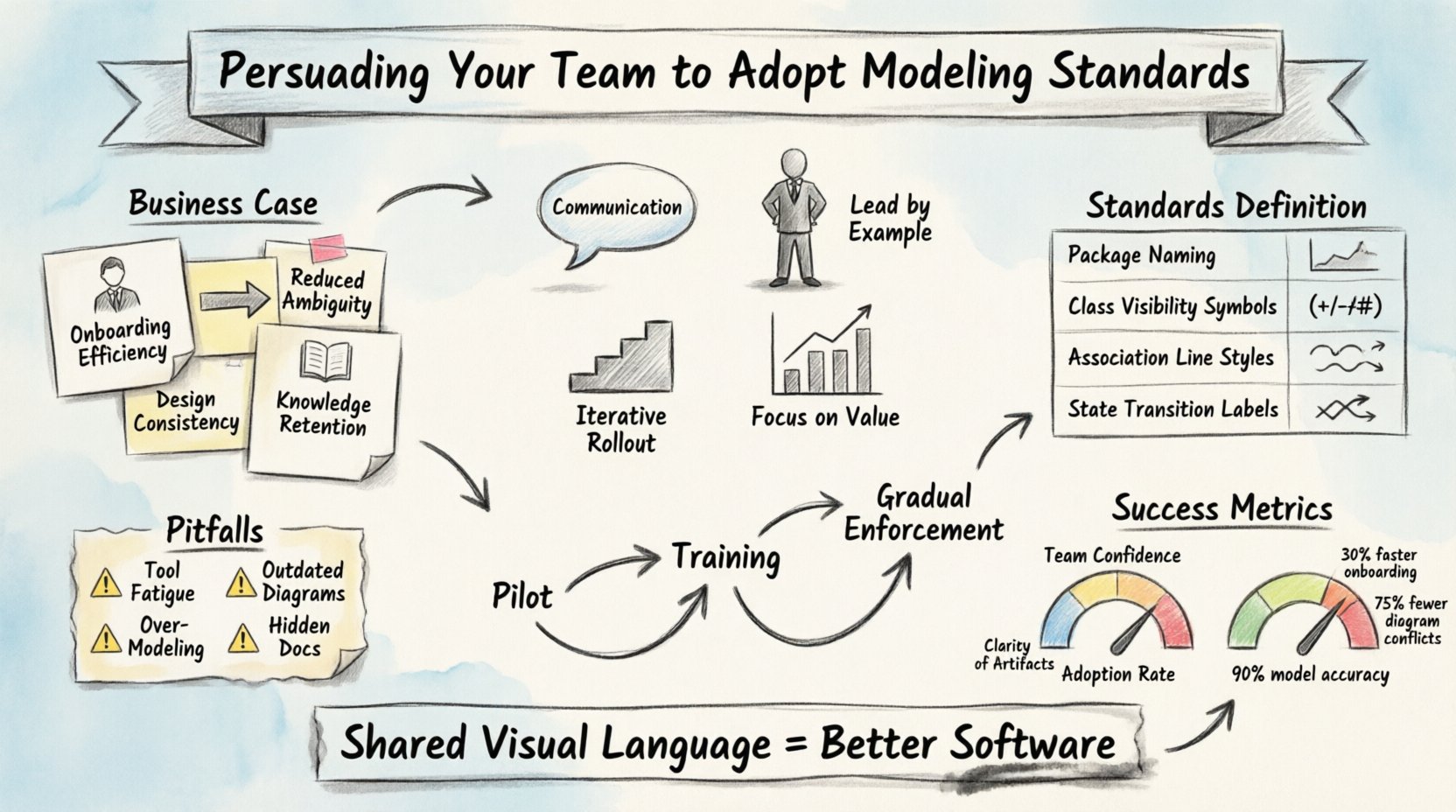
- Communication is Key: Modeling standards reduce ambiguity and align technical and business stakeholders.
- Lead by Example: Adoption rates increase significantly when leadership consistently uses the standards in their own work.
- Iterative Rollout: Introduce standards gradually to avoid overwhelming the team with immediate compliance requirements.
- Focus on Value: Frame the standards as a tool for efficiency and reduced defects, not just administrative overhead.
Creating software is a collaborative effort that requires precise communication. When teams work across different domains, the gap between intent and implementation often widens. Unified Modeling Language (UML) diagrams serve as a universal bridge, translating complex logic into visual structures. However, without agreed-upon standards, these diagrams can become as confusing as the code they attempt to describe. This article outlines a structured approach to convincing a team to adopt consistent modeling standards, ensuring that visual documentation adds value rather than becoming a burden.
Understanding the Resistance 🛑
Resistance to new processes is natural. Developers often view documentation as a distraction from the tangible work of writing code. When proposing modeling standards, it is crucial to acknowledge this sentiment rather than dismiss it. The perception that modeling slows down delivery is a common barrier. To overcome this, you must demonstrate how standardized diagrams actually accelerate the development lifecycle by reducing rework and clarifying requirements early.
Teams may also worry about rigidity. If the standards are too strict, creativity can suffer. The goal is to establish a shared language that facilitates understanding, not to constrain architectural freedom. You should frame the adoption of standards as a means to reduce cognitive load. When everyone uses the same notation for a sequence diagram or a class relationship, reading the architecture becomes instantaneous.
The Business Case for Standards 📊
Before introducing specific rules, you need to articulate the return on investment. Stakeholders need to see why this effort matters. Here are the primary benefits of adopting a standardized modeling approach:
- Onboarding Efficiency: New team members can understand the system architecture faster when diagrams follow a predictable pattern.
- Reduced Ambiguity: Specific notation for data flows and state changes eliminates interpretation errors between developers and analysts.
- Design Consistency: A standardized structure ensures that high-level views match the implementation details.
- Knowledge Retention: When staff leave, the documentation remains clear and understandable without needing lengthy handover sessions.
Defining the Standards Clearly 📝
A vague directive to “use better diagrams” will fail. You need concrete guidelines. The standards should cover the most common diagram types used in your workflow, such as Class Diagrams, Sequence Diagrams, and Activity Diagrams.
Consider the following areas for standardization:
| Element | Standard Recommendation | Reasoning |
|---|---|---|
| Package Naming | Use domain-driven prefixes (e.g., core., api.) |
Instantly identifies the layer of the system. |
| Class Visibility | Explicitly mark public (+), private (-), and protected (#) | Clarifies encapsulation boundaries immediately. |
| Association Lines | Use solid lines for aggregation, dashed for dependencies | Distinguishes lifecycle ownership from usage. |
| State Transitions | Label all transition triggers and guards | Ensures no edge cases are overlooked during coding. |
By defining these rules explicitly, you remove the guesswork. Team members know exactly what is expected when they create a new diagram. This clarity reduces the friction of review cycles, as reviewers can focus on logic rather than formatting inconsistencies.
Implementation Strategy 🚀
Rolling out new standards requires a phased approach. A sudden mandate often leads to backlash and half-hearted compliance. Instead, consider a pilot program.
Phase 1: The Pilot
Select one project or one team to test the standards. This group will face the real-world challenges of the new rules. Gather their feedback on what is cumbersome and what is helpful. Adjust the guidelines based on this feedback. This collaborative approach signals that the standards are there to help, not to hinder.
Phase 2: Training and Resources
Before expanding, provide training. Hold workshops where the team practices creating diagrams according to the new rules. Create a template library so members can start with a pre-formatted structure. Providing the tools to succeed makes adoption much easier than simply demanding compliance.
Phase 3: Gradual Enforcement
Integrate the standards into the definition of done. Initially, this might mean a quick check during code review. Over time, non-compliant diagrams should be flagged. However, allow a grace period where minor formatting issues are corrected without blocking progress. The focus should remain on the content of the model, not the perfection of the drawing.
Addressing Common Pitfalls 🚧
Even with a plan, things can go wrong. Here are common obstacles and how to navigate them:
- Tool Fatigue: If the modeling tool is slow or difficult to use, adoption will stall. Ensure the chosen platform supports the standards efficiently.
- Outdated Diagrams: If the diagrams do not match the code, they become noise. Enforce a rule that diagrams are updated alongside code changes. If this is not feasible, focus on high-level architecture only.
- Over-Modeling: Teams may try to diagram everything. Limit the scope to critical paths and complex logic. Not every class needs a diagram.
- Lack of Visibility: If diagrams are stored in a private folder, they are useless. Ensure they are accessible to the whole team and reviewed in regular meetings.
Measuring Success 📈
How do you know if the standards are working? Look for qualitative and quantitative shifts.
Qualitative Metrics: Ask the team during retrospectives. Are code reviews faster? Is the onboarding process smoother? Do stakeholders understand the system better?
Quantitative Metrics: Track the number of defects found in the requirements phase versus the testing phase. If early modeling catches logic errors, the defect rate in later stages should drop. You can also measure the time spent creating documentation versus the time saved during integration.
Tracking these metrics provides evidence of value. When the team sees that the standards actually reduce their pain points, resistance naturally decreases. It shifts the narrative from “extra work” to “better work”.
Sustaining Compliance 🛡️
Maintaining standards is easier than starting them. Once the habit is formed, compliance becomes the norm. However, vigilance is required. A rotating “standards champion” can review diagrams periodically to ensure consistency. This role does not need to be a gatekeeper, but rather a guide who helps new contributors understand the rules.
Regularly update the guidelines as the team evolves. Software architecture changes, and standards should reflect the current reality of the product. Avoid stagnation by inviting feedback on the standards themselves. If a rule no longer serves a purpose, remove it. This flexibility builds trust.
Conclusion 🏁
Persuading a team to adopt modeling standards is less about enforcing rules and more about aligning incentives. When the team understands that consistent diagrams lead to fewer bugs, faster onboarding, and clearer communication, adoption becomes a shared goal. By defining clear conventions, piloting the approach, and measuring the impact, you can build a culture where documentation is valued as much as code.
The journey toward standardized modeling requires patience and leadership. It is not about creating perfect diagrams for the sake of aesthetics. It is about creating a shared visual language that empowers the entire team to build better software together. With the right strategy, modeling becomes an asset that accelerates delivery rather than a hurdle that slows it down.