

💡 Key Takeaways
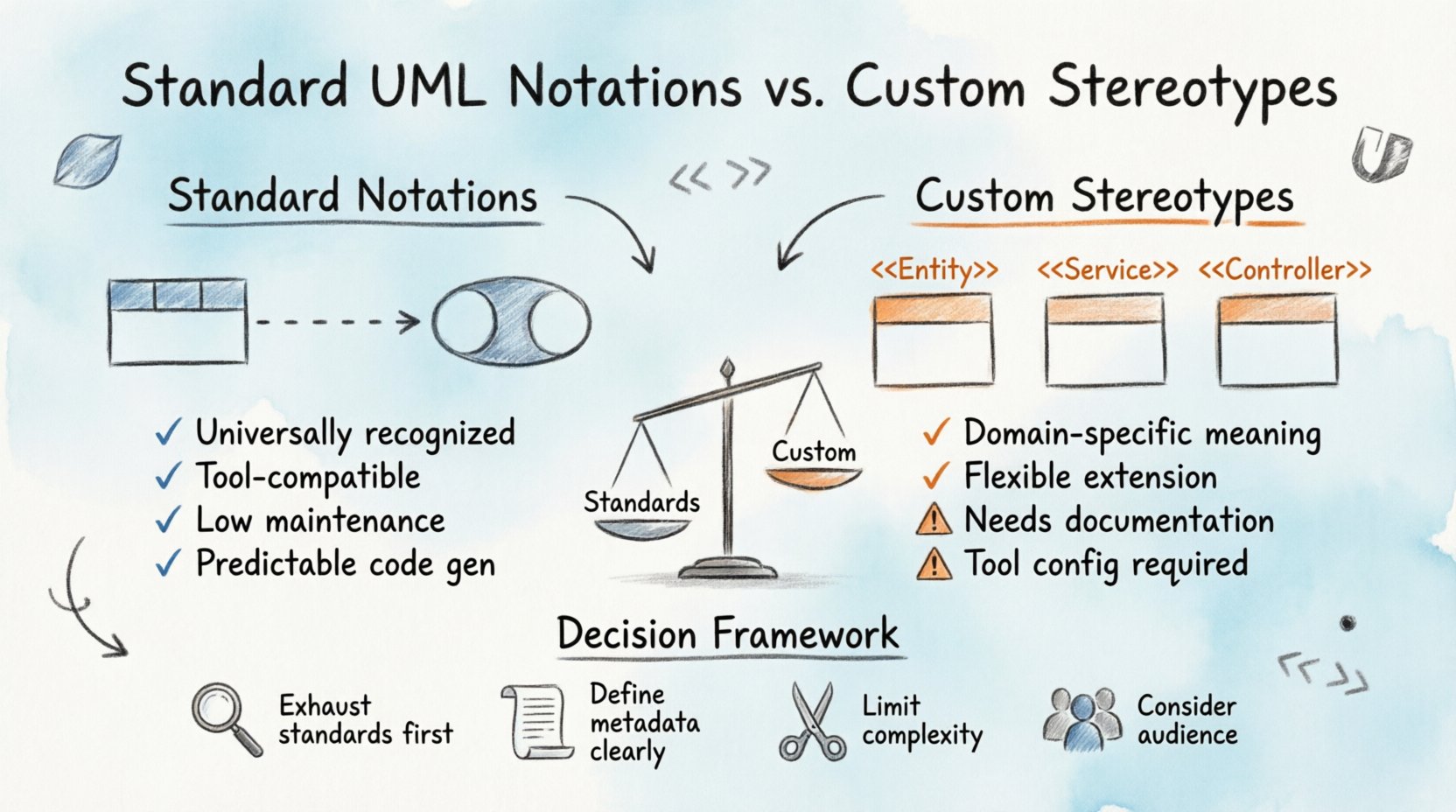
- Standard Notations: These are universally recognized symbols within the Unified Modeling Language that ensure clarity across different teams and tools.
- Custom Stereotypes: These allow modelers to extend the language to fit specific domain needs, but they require strict documentation to remain understandable.
- Tooling Compatibility: Standard elements work seamlessly across most modeling platforms, whereas custom stereotypes may need specific configuration to render correctly.
- Balance: Prioritize standard notation for general structure and use stereotypes only when standard elements fail to convey necessary semantic meaning.
Unified Modeling Language (UML) serves as the backbone of object-oriented analysis and design. It provides a standardized way to visualize the design of a system. However, as systems grow in complexity, the rigid structure of standard UML can sometimes feel restrictive. This tension leads modelers to ask: when should we adhere to the standard, and when is it appropriate to extend the language? Understanding the distinction between standard notations and custom stereotypes is crucial for maintaining model integrity and communication efficiency.
Understanding Standard UML Notations 📐
Standard notations refer to the elements defined by the Object Management Group (OMG) in the UML specification. These include classes, interfaces, use cases, sequences, and state machines. Every element has a specific shape, icon, and set of allowed connections. For instance, a class is represented by a rectangle divided into three compartments: name, attributes, and operations. A dependency is shown as a dashed line with an open arrow.
The primary advantage of using standard notations is interoperability. When a modeler creates a diagram using standard elements, any other modeler using a compliant tool can read the diagram without confusion. This universality is vital for large organizations where multiple teams may work on different parts of the same architecture.
Benefits of Standardization
- Universal Understanding: A developer joining a new project can immediately recognize the diagram elements without needing a glossary.
- Tool Support: Code generation, reverse engineering, and validation tools are built around these standards. They expect specific syntax to function correctly.
- Documentation Consistency: Standard elements ensure that documentation remains consistent with the actual implementation patterns widely accepted in the industry.
The Role of Custom Stereotypes 🎭
While standards provide a strong foundation, they are not infinite. Sometimes, a system domain requires specific semantics that standard UML cannot express. This is where stereotypes come into play. A stereotype is a mechanism that allows modelers to create new metaclasses based on existing ones. In visual notation, stereotypes are typically denoted by text enclosed in guillemets, such as <<Entity>> or <<Service>>, placed above the element name.
Stereotypes extend the vocabulary of UML without changing the underlying structure. You might apply a stereotype to a class to indicate that it represents a database entity, or to a package to denote a specific deployment tier. This allows the model to carry domain-specific meaning that a plain class rectangle could not convey.
When to Use Stereotypes
Custom stereotypes are most effective when the standard elements are too generic. For example, a standard Class does not distinguish between a UI component and a business logic processor. By applying a stereotype, you can visually distinguish these roles within the same diagram type. This is particularly useful in large-scale enterprise architectures where clear separation of concerns is critical.
Comparison: Standard vs. Custom 📊
To make an informed decision, it is helpful to compare the two approaches directly. The following table outlines the key differences in functionality, maintenance, and portability.
| Feature | Standard Notations | Custom Stereotypes |
|---|---|---|
| Readability | High. Recognized by all UML practitioners. | Variable. Requires domain knowledge to interpret. |
| Tool Compatibility | Native support across all modeling tools. | May require custom plugins or configuration. |
| Flexibility | Fixed. Limited to the UML specification. | High. Adaptable to specific project needs. |
| Maintenance | Low effort. Stable over time. | High. Needs updates if domain changes. |
| Code Generation | Predictable and reliable. | Dependent on tool configuration rules. |
Implementation Guidelines 🛠️
Deciding between standard elements and stereotypes requires a disciplined approach. The goal is to maximize clarity while minimizing technical debt. Here are several guidelines to follow when designing models.
1. Exhaust Standard Options First
Before defining a new stereotype, verify that standard UML elements cannot achieve the same result. For example, instead of creating a stereotype for a database table, consider using a specific notation for a database within the standard package structure. Only introduce extensions when the standard elements create ambiguity.
2. Define Metadata Clearly
If a stereotype is necessary, document its meaning thoroughly. A stereotype is only useful if its semantics are known. Create a glossary or a meta-model definition that explains what <<Controller>> implies about the underlying code. This documentation should be versioned alongside the model.
3. Limit Complexity
Do not stack stereotypes excessively. Using multiple layers of customization can make a diagram unreadable. A class labeled <<DTO>><<Serializable>> is harder to parse than a single, well-defined stereotype. Keep the visual representation clean.
4. Consider the Audience
Who will read the model? If the audience includes external partners or new hires, standard notations are safer. If the model is for a closed team with deep domain expertise, custom stereotypes can significantly speed up communication.
Impact on Maintenance and Evolution 🔄
Models are living documents. They evolve as the system changes. Standard notations are stable because the UML specification changes slowly. Custom stereotypes, however, are subject to project-specific evolution. If the team decides to change the definition of <<Repository>> next year, the model must be updated everywhere that stereotype appears.
This dependency creates a maintenance burden. Teams often find that over time, their custom library of stereotypes becomes a unique dialect that is difficult to maintain. It is advisable to audit the stereotypes used in a project periodically. Remove those that are no longer necessary or consolidate those that overlap in meaning.
Tooling and Automation Considerations ⚙️
Automation is a key driver for using modeling languages. Scripts that generate code or documentation rely on the structure of the model. Standard elements are widely supported by these automation scripts. Custom stereotypes may break these scripts unless they are explicitly programmed to handle them.
For example, a code generator might look for a specific class pattern to create a database entity. If that class uses a custom stereotype, the generator must be configured to recognize that tag. If the tooling team does not maintain this configuration, the model becomes a documentation artifact that does not reflect the actual system.
Strategic Decision Making 🧭
The choice between standard and custom is not binary. A healthy model often uses a hybrid approach. Use standard notations for the structural backbone of the system, such as the hierarchy of packages and the relationships between major components. Use stereotypes to annotate specific behaviors or roles within that structure.
Consider the lifecycle of the project. In the early stages, standard notations allow for rapid prototyping and easier collaboration. As the system matures and specific patterns emerge, introducing stereotypes can help codify those patterns. However, this transition should be managed carefully to avoid fragmenting the team’s understanding.
Final Thoughts on Model Clarity 🎯
The ultimate goal of modeling is communication. Whether you choose standard notations or custom stereotypes, the metric of success is how easily the information is conveyed to stakeholders. Over-engineering the model with unnecessary custom elements can obscure the design rather than clarify it. Conversely, sticking strictly to standards when domain specificity is required can lead to confusion.
By weighing the benefits of interoperability against the need for domain precision, teams can create models that are both robust and expressive. Regular reviews of the modeling standards help ensure that the balance remains appropriate as the technology stack and team structure evolve.