

Object-oriented modeling (OOM) serves as the architectural blueprint for modern software systems. It shifts the focus from procedural logic to structured data and behavior. Unified Modeling Language (UML) provides the standard notation to visualize, specify, construct, and document these systems. Understanding the fundamental principles allows architects to design scalable, maintainable, and robust applications without relying on specific tools.
💡 Key Takeaways
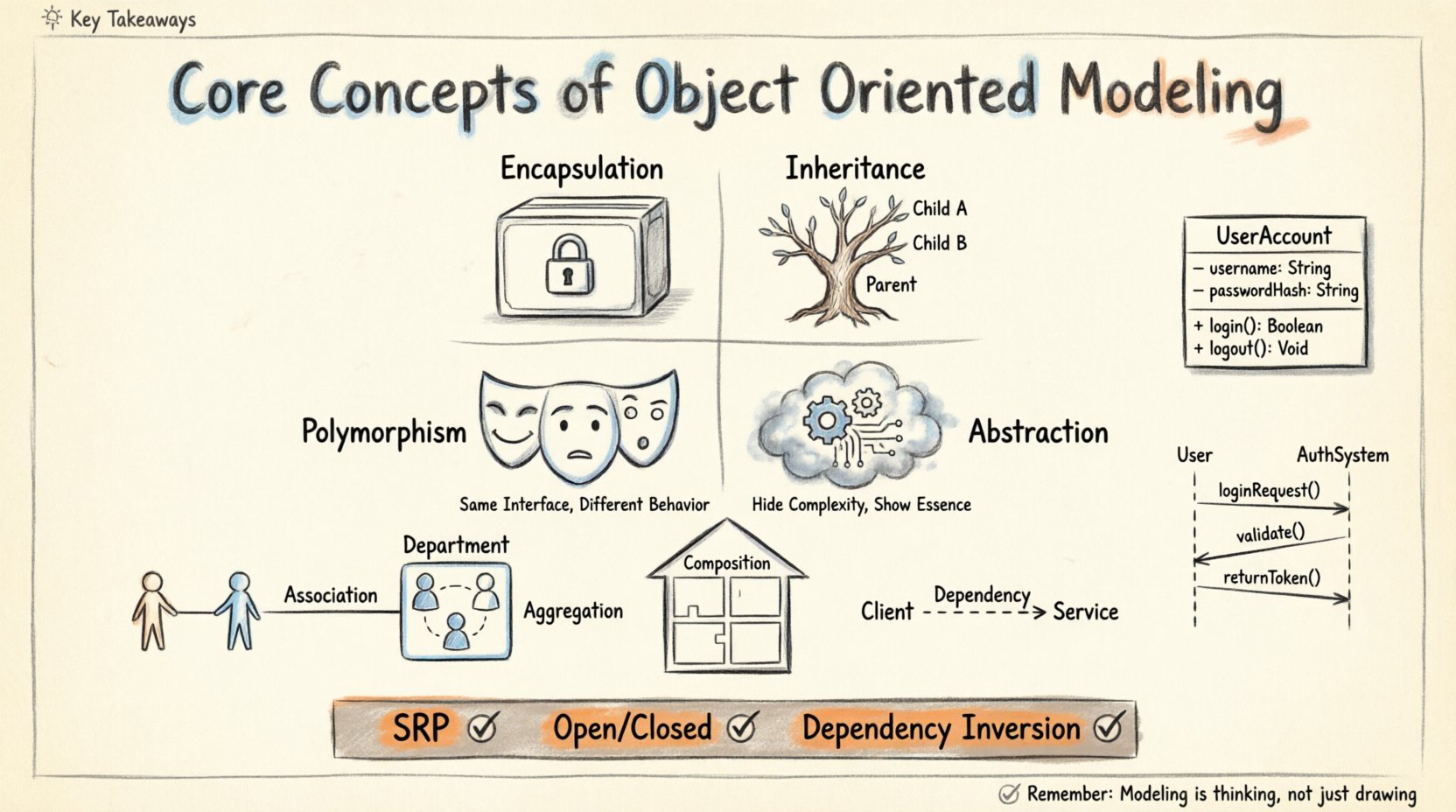
Encapsulation & Data Hiding: Bundles data and methods together, restricting direct access to internal state.
Inheritance & Reusability: Allows new classes to derive properties and behaviors from existing ones, reducing redundancy.
Polymorphism & Flexibility: Enables objects to be treated as instances of their parent class, allowing interchangeable usage.
Abstraction & Simplicity: Focuses on essential features while hiding complex background details from the user.
UML Diagrams: Visual tools like Class and Sequence diagrams clarify system structure and interactions.
1. The Foundation: Classes and Objects 🧱
At the heart of object-oriented modeling lies the distinction between a class and an object. A class acts as a blueprint or template. It defines the structure and behavior common to a set of items. An object is a specific instance created from that blueprint.
Consider a database schema for a library system. The Book class defines attributes like title, author, and ISBN. It also defines methods like checkout or return. When a specific book, say “The Art of War”, is entered into the system, it becomes an object. This object holds the specific values for those attributes.
This separation allows for consistency. If the Book class is updated to require a publication year, every new object created inherits this requirement automatically. Old objects retain their existing data, ensuring stability while the model evolves.
2. The Four Pillars of Object Orientation 🏛️
Object-oriented design relies on four primary concepts that govern how data and logic interact. These pillars ensure that models remain modular and manageable.
2.1 Encapsulation 🔒
Encapsulation involves bundling data (attributes) and methods (operations) that operate on that data into a single unit. Crucially, it restricts direct access to some of an object’s components. This is often achieved through access modifiers.
Public: Accessible from anywhere.
Private: Accessible only within the class itself.
Protected: Accessible within the class and its subclasses.
By hiding internal state, encapsulation prevents external code from putting the object into an invalid state. It forces interaction through well-defined interfaces, reducing coupling between different parts of the system.
2.2 Inheritance 🌳
Inheritance allows a new class to adopt the properties and methods of an existing class. The existing class is the parent or superclass. The new class is the child or subclass.
This promotes code reuse. Instead of rewriting logic for common behaviors, developers define them once in the parent. For example, a Vehicle class might define startEngine and stopEngine. A Car class and a Truck class can inherit these methods while adding specific behaviors like drive or loadCargo.
2.3 Polymorphism 🎭
Polymorphism allows objects of different types to be treated as objects of a common superclass. This means a single interface can be used to represent different underlying forms.
In a simulation, a function move() can accept any object derived from Character. Whether the object is a Warrior or a Mage, the move() call is valid. The specific implementation varies based on the object’s type. This flexibility simplifies code structure and makes it easier to add new types without modifying existing logic.
2.4 Abstraction 🎨
Abstraction focuses on hiding complex implementation details and showing only the essential features of the object. It helps manage complexity by breaking a system into manageable modules.
When a user interacts with a payment gateway, they see a simple processPayment() button. They do not see the encryption algorithms, database transactions, or network protocols running in the background. The model abstracts this complexity away, presenting a clean interface.
3. Relationships Between Objects 🔗
Objects do not exist in isolation. They relate to one another through various associations. Understanding these relationships is critical for accurate modeling.
3.1 Association 🤝
An association represents a structural link between two classes. It defines that objects of one class are connected to objects of another. For example, a Student is associated with a Course. This can be one-to-one, one-to-many, or many-to-many.
3.2 Aggregation 🧩
Aggregation is a specific type of association representing a “whole-part” relationship. The parts can exist independently of the whole.
Consider a Department and Employees. If the Department is dissolved, the Employees still exist as independent entities. The relationship is weak; the lifecycle of the part does not depend on the whole.
3.3 Composition 🧱
Composition is a stronger form of aggregation. The parts cannot exist without the whole. The lifecycle of the part is tied to the lifecycle of the whole.
Think of a House and its Rooms. If the House is demolished, the Rooms cease to exist as part of that structure. This indicates a strong ownership and dependency within the model.
3.4 Dependency ⚡
Dependency represents a usage relationship. One class depends on another for its implementation or operation, but does not own it.
If a ReportGenerator class uses a DatabaseConnector class temporarily to fetch data, it has a dependency. If the connector changes, the generator might need adjustment, but it does not own the connector’s existence.
4. Visualizing the Model with UML 📐
Unified Modeling Language provides visual representations to communicate these concepts effectively. Several diagram types are essential for object-oriented modeling.
4.1 Class Diagrams
Class diagrams are the backbone of static structure modeling. They show classes, their attributes, operations, and the relationships among objects. They are used to define the blueprint of the system.
Element | Description |
|---|---|
Class Name | Identifies the entity (e.g., Customer). |
Attributes | Data stored within the class. |
Methods | Behaviors or functions available to the class. |
Relationships | Lines connecting classes (Association, Inheritance). |
4.2 Object Diagrams
Object diagrams show a snapshot of the system at a specific moment. They represent actual instances rather than general classes. These are useful for debugging and understanding complex associations.
4.3 Sequence Diagrams
Sequence diagrams illustrate interactions over time. They show how objects communicate to achieve a specific task. Vertical lines represent the timeline, and horizontal arrows represent messages passed between objects.
5. Design Principles for Robust Modeling 🛡️
Creating a model is not just about drawing boxes and lines. It requires adherence to design principles that ensure long-term viability.
5.1 Single Responsibility Principle
Every class should have a single reason to change. If a class handles both database connections and user interface rendering, it becomes too complex. Splitting these concerns improves maintainability.
5.2 Open/Closed Principle
Entities should be open for extension but closed for modification. You should be able to add new functionality by adding new classes rather than altering existing ones. This reduces the risk of introducing bugs into stable code.
5.3 Dependency Inversion
High-level modules should not depend on low-level modules. Both should depend on abstractions. This decouples the system, allowing parts to be swapped without breaking the whole.
6. Common Modeling Pitfalls ⚠️
Even experienced architects encounter challenges. Awareness of common errors helps avoid them.
Over-Engineering: Creating complex hierarchies where simple structures suffice. This adds unnecessary cognitive load.
Ignoring Relationships: Focusing too much on individual classes and neglecting how they interact leads to integration issues later.
Static vs. Dynamic: Failing to model how the system behaves over time. Static diagrams are necessary but not sufficient for understanding execution flow.
Lack of Consistency: Using different notations for the same concepts confuses stakeholders and developers.
7. The Evolution of Modeling 🚀
Modeling techniques continue to evolve. While the core concepts of objects and relationships remain constant, the tools and methods adapt to new paradigms like microservices and cloud-native architectures. The ability to abstract and model complex systems remains the primary skill for system architects.
By grounding development in solid object-oriented principles, teams can build systems that are easier to understand, modify, and extend. The investment in clear modeling pays dividends throughout the lifecycle of the software.