
Modern business operates at a pace that renders static IT models obsolete. As organizations scale, the complexity of their technology ecosystems expands exponentially. Often, this growth occurs without a cohesive blueprint, leading to a landscape defined by friction rather than flow. When technology stops serving the business and starts hindering it, the need for structure becomes undeniable.
An Enterprise Architecture (EA) function is not merely a department of diagramming and documentation. It is the structural framework that aligns technology capabilities with business strategy. It ensures that every investment, system integration, and data flow contributes to the broader organizational goals. Without this alignment, resources dissipate into redundant efforts and unmanaged risks.
How do you know if your organization has reached this tipping point? There are specific, measurable indicators that suggest a formal EA function is required to restore order and strategic clarity. This guide outlines the five critical signs that your IT landscape requires a dedicated architecture function to drive sustainable growth.
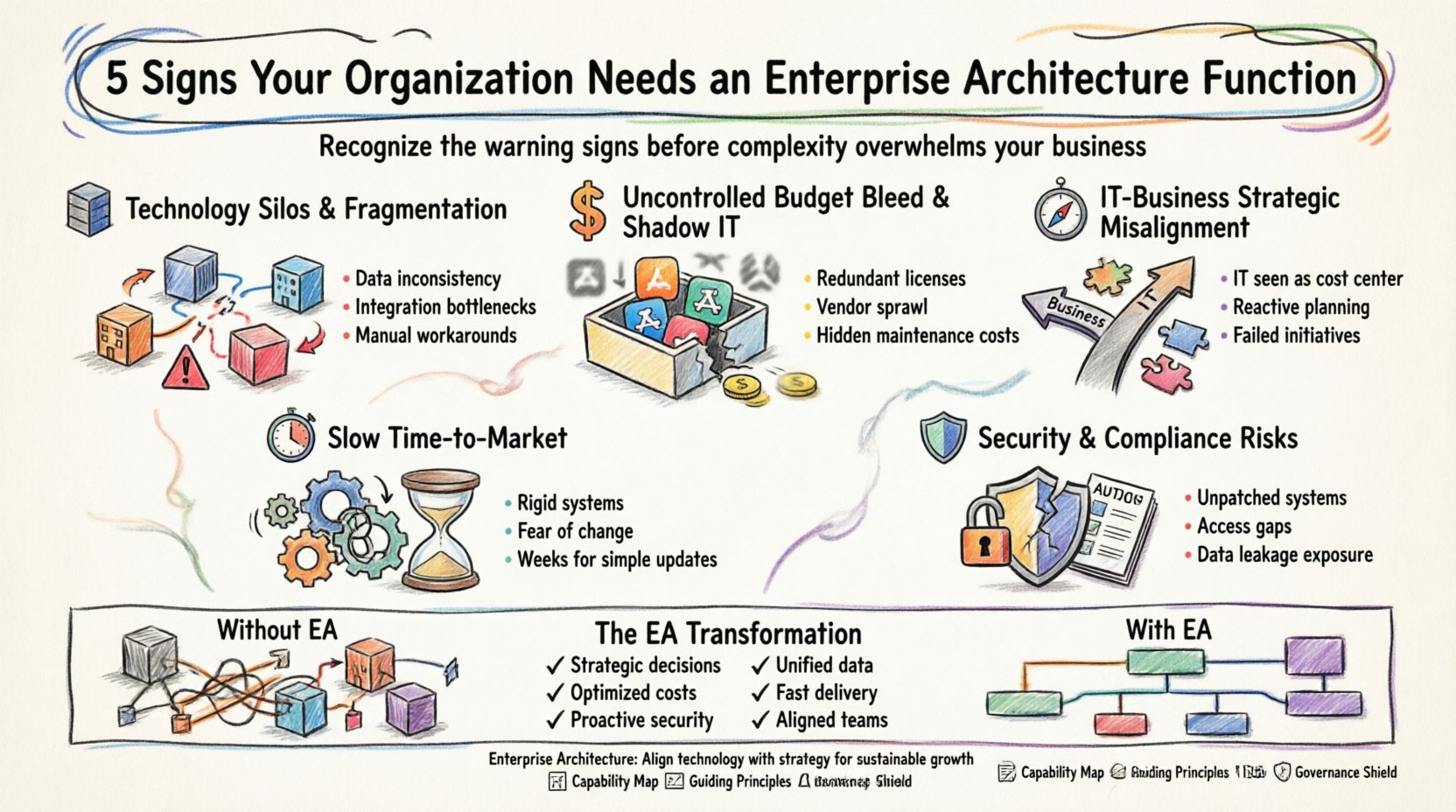
1. Persistent Technology Silos and Fragmentation 🧱
The most visible symptom of a missing architectural strategy is the existence of technology silos. In a healthy environment, data and applications communicate seamlessly. In a fragmented environment, information is trapped within isolated systems, creating barriers to operational efficiency.
When silos exist, the organization suffers from data inconsistency. The finance department may report different figures than the sales team because they are pulling data from disconnected databases. This discrepancy forces leadership to spend valuable time reconciling numbers rather than analyzing trends. It creates a false sense of security where decisions are made on incomplete or conflicting information.
- Data Integrity Issues: Customer records are duplicated across multiple platforms, leading to communication errors and compliance risks.
- Integration Bottlenecks: Every new project requires a bespoke integration effort, slowing down deployment and increasing costs.
- Operational Inefficiency: Employees must manually transfer data between systems, introducing human error and wasting labor hours.
Without an EA function, these silos are often addressed reactively. Teams build bridges between systems only when a specific crisis occurs. A proactive architecture function maps the data flow and application landscape before issues arise, ensuring that connectivity is designed into the system from the start.
2. Uncontrolled Budget Bleed and Shadow IT 💸
Financial visibility is a cornerstone of effective governance. When an organization lacks an architecture function, IT spending often becomes opaque. Leadership may believe they are investing in a unified platform, while the reality involves dozens of overlapping subscriptions and redundant licenses.
This phenomenon is frequently driven by shadow IT. Departments procure their own software solutions without central oversight. While this might seem like empowerment, it results in a fragmented technology stack that is difficult to manage, secure, and maintain. The cumulative cost of these unmanaged tools can consume a significant portion of the IT budget.
Consider the mechanics of this waste:
- Redundant Licensing: Multiple departments purchase similar tools, paying full price for features that exist elsewhere in the organization.
- Vendor Sprawl: Too many vendors mean higher administrative overhead and reduced negotiating power for contract renewals.
- Maintenance Costs: Legacy systems that are no longer aligned with strategy still require support, draining resources from innovation.
An Enterprise Architecture function provides the visibility needed to consolidate the technology stack. By auditing existing assets and mapping them against business needs, EA identifies what to retire, what to standardize, and what to invest in. This discipline directly improves the return on investment for technology spending.
3. Strategic Misalignment Between IT and Business 🧭
The most damaging consequence of missing architecture is the disconnect between technology capabilities and business objectives. When IT operates in a vacuum, it builds systems that are technically sound but business-irrelevant. Conversely, business units drive initiatives that are technically unfeasible or unsustainable.
Strategic alignment requires a shared language. Business leaders speak in terms of revenue, market share, and customer experience. IT leaders speak in terms of latency, uptime, and protocols. An EA function acts as the translator, converting business requirements into technical specifications and vice versa.
Signs of this misalignment include:
- IT as a Cost Center: Technology is viewed solely as an expense rather than a strategic enabler.
- Reactive Planning: IT capacity planning is driven by immediate outages rather than future growth projections.
- Failed Initiatives: Projects that launch on time and on budget fail to deliver the intended business value because the underlying architecture did not support the goal.
Without this bridge, the organization moves in two different directions. The business wants to expand into new markets, but the technology infrastructure cannot support the required data volume or speed. EA ensures that the roadmap for technology development matches the roadmap for business expansion.
4. Slow Time-to-Market and Deployment Bottlenecks ⏱️
In a competitive landscape, speed is a critical differentiator. If your organization struggles to launch new features or bring products to market, the technology foundation may be the culprit. A lack of architectural governance often results in a rigid environment where change is difficult and risky.
When systems are tightly coupled and undocumented, making a change in one area can have unforeseen consequences in another. This fear of breaking things leads to hesitation and slow approval processes. Teams spend weeks understanding dependencies before they can deploy a simple update.
A robust architecture function enables agility through standardization:
- Standardized Interfaces: When APIs and data models are standardized, new applications can plug into the ecosystem quickly without custom coding.
- Reusable Components: Common capabilities, such as authentication or reporting, are built once and reused across projects.
- Clear Decision Rights: Teams know who is responsible for specific architectural decisions, reducing wait times for approvals.
By designing for flexibility, the organization reduces the friction associated with change. This allows the business to respond to market shifts with the speed required to maintain a competitive edge.
5. Increased Security and Compliance Risks 🛡️
Security is not just a perimeter defense; it is a design principle. When architecture is an afterthought, security gaps appear in the design of the system itself. A disorganized IT landscape makes it nearly impossible to maintain a consistent security posture across all assets.
Regulatory compliance adds another layer of complexity. Data privacy laws require specific handling of information, regardless of where it resides. If data flows are not mapped and understood, the organization cannot prove compliance during an audit. This exposes the company to fines, legal action, and reputational damage.
The risks associated with poor architecture include:
- Unpatched Systems: Without a clear inventory of assets, legacy systems often remain unpatched and vulnerable.
- Access Control Gaps: Inconsistent user management leads to excessive privileges and unauthorized access.
- Data Leakage: Poorly defined data flows can inadvertently expose sensitive information to external parties.
An EA function embeds security into the lifecycle of every system. It ensures that security requirements are defined at the design phase, not the testing phase. This proactive approach reduces the attack surface and simplifies the path to compliance.
Current State vs. Architecturally Mature State
To better understand the impact of establishing an Enterprise Architecture function, consider the comparison below. This table illustrates the shift from a reactive, fragmented model to a proactive, structured model.
| Area | Without EA Function | With EA Function |
|---|---|---|
| Decision Making | Driven by immediate requests and vendor hype | Driven by strategic roadmap and long-term value |
| Data Management | Fragmented, inconsistent, difficult to access | Unified, governed, accessible across the organization |
| Cost Efficiency | High waste due to redundancy and shadow IT | Optimized spending through consolidation and reuse |
| Security Posture | Reactive patching and compliance gaps | Proactive design and continuous monitoring |
| Speed of Delivery | Slow due to integration complexity | Fast due to standardized components and APIs |
| Business Alignment | IT and Business operate in parallel tracks | IT and Business are integrated partners |
The Mechanics of an Effective Enterprise Architecture
Implementing an EA function requires more than just hiring a few architects. It involves a shift in how the organization views its technology assets. The function operates through several key mechanisms that drive value without relying on specific tools or vendors.
1. Capability Mapping
This process involves identifying what the organization needs to do to succeed, known as capabilities. Instead of focusing on software, the focus is on business functions like “Order Management” or “Customer Support.” Technology is then mapped to these capabilities. This ensures that every dollar spent on technology directly supports a business capability.
2. Principle Definition
Principles are the guiding rules that govern technology decisions. Examples include “Data is an asset” or “Buy before build.” These principles provide a framework for decision-making that is consistent across all departments. When a new project arises, teams check the principles to ensure alignment before development begins.
3. Roadmap Development
A technology roadmap visualizes the current state and the future state. It outlines the steps required to move from one to the other. This roadmap is not static; it evolves as business needs change. It provides a clear timeline for migration, retirement, and modernization efforts.
4. Governance Framework
Governance ensures that decisions are made correctly and consistently. This involves establishing committees and review processes. It does not mean slowing things down; it means ensuring that the right choices are made the first time. Governance protects the organization from technical debt accumulating in the system.
Building the Case for Implementation
Convincing leadership to establish an Enterprise Architecture function requires a clear business case. You must demonstrate that the cost of the function is less than the cost of the current inefficiencies. Use the data you have collected regarding budget waste, security incidents, and missed deadlines.
Start small if necessary. You do not need to build a massive department overnight. Begin with a core team that focuses on the most critical areas of fragmentation. As value is demonstrated, expand the scope. The goal is to create a culture where architecture is seen as a value driver, not a bureaucratic hurdle.
Communication is key. Translate architectural concepts into business language. Do not talk about data models; talk about data accessibility. Do not talk about API gateways; talk about integration speed. This ensures that stakeholders understand the value proposition.
Challenges in Adoption
Even with a strong case, adoption can be difficult. Resistance often comes from teams that prefer autonomy over standardization. They may view architecture as a constraint on their creativity. It is important to address this mindset early.
Standardization should not mean stagnation. The goal is to provide a foundation that allows teams to innovate safely. Think of it as building a highway system. The lanes are defined, but the cars can travel at any speed within the limits. This structure actually enables faster travel by preventing collisions and bottlenecks.
Another challenge is the long-term nature of architectural value. The benefits of EA are often realized over years, not quarters. Leadership must be willing to invest in long-term stability even when short-term pressures exist. This requires a partnership between IT leadership and the executive board.
Final Thoughts on Structural Integrity
Organizational growth without structural support is unsustainable. The five signs outlined in this guide are not merely IT problems; they are organizational symptoms. They indicate that the underlying framework is too weak to support the weight of the business.
Addressing these signs requires more than a new tool or a quick fix. It requires a fundamental shift in perspective. Technology must be viewed as a cohesive system that supports the business mission. An Enterprise Architecture function provides the discipline and the vision needed to make this shift.
The investment in architecture is an investment in resilience. It prepares the organization for the changes that are inevitable in the digital age. By aligning strategy with execution, the organization can navigate complexity with confidence and clarity.
Recognizing the need for structure is the first step. Taking action to build it is the second. The difference between a chaotic IT environment and a strategic one is often just a matter of intentional design.