
Now Reading: Visual Paradigm AI State Machine Diagram Generator: Text to UML States
-
01
Visual Paradigm AI State Machine Diagram Generator: Text to UML States


Visual Paradigm AI State Machine Diagram Generator: Text to UML States
Modeling how an object changes over time — from pending to shipped, open to resolved, or idle to active — used to mean painstakingly placing states, drawing transitions, and writing guards. Visual Paradigm’s AI State Machine Diagram Generator flips that. Describe the lifecycle in natural language, and get a clean, UML-compliant state machine diagram in seconds. No more tedious manual layout. Just fast, accurate behavioral models that make system logic crystal clear.
Why This AI State Machine Tool Wins
- Plain text → full UML state machine with states, transitions, guards & events
- Auto-detects initial/final states, composite states, and loops
- Handles complex lifecycles: orders, tickets, sessions, protocols
- Native editable model — add actions, refine guards, link to classes
- Desktop depth + browser chatbot for quick or deep modeling
1. Desktop: Prompt → Complete Behavioral Model
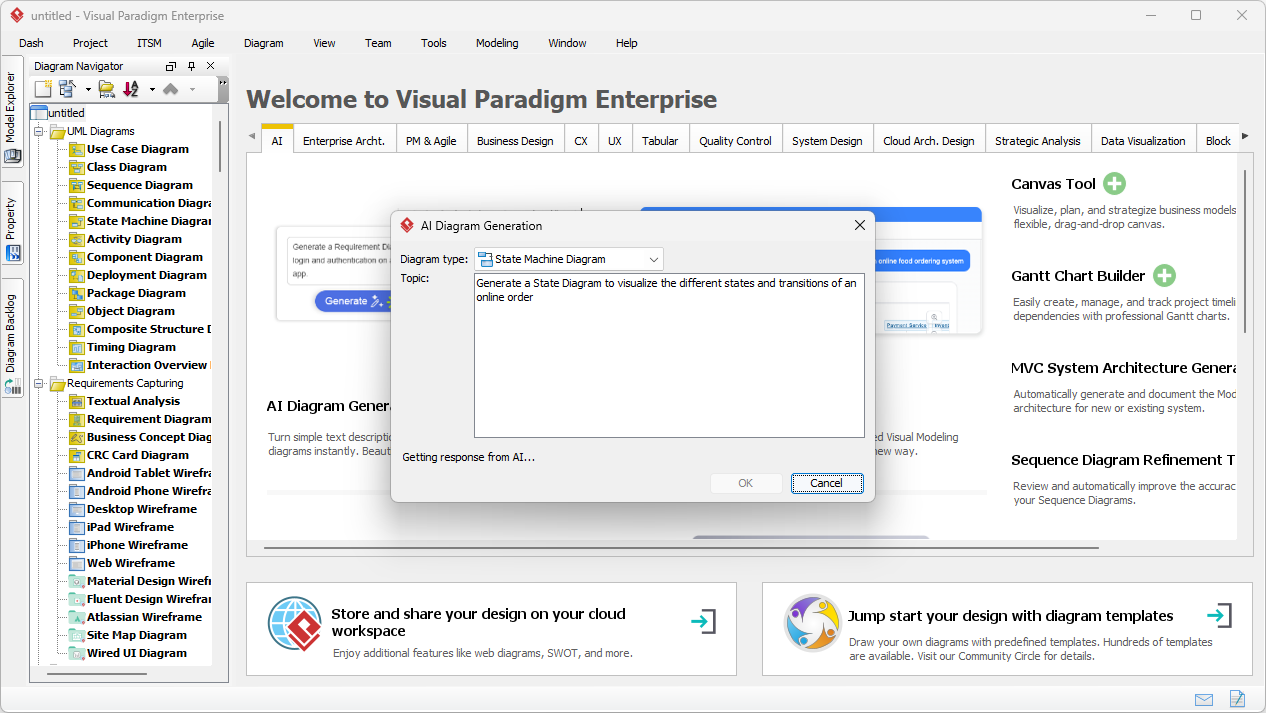
Tools → AI Diagram Generation → select “State Machine Diagram” → describe the behavior:
“Create a UML state machine diagram for an online order lifecycle: starts as Created, then Pending Payment, Paid, Processing, Shipped, Delivered, or Cancelled at any point before Delivered. Include guards like ‘[payment successful]’ and events like ‘customer cancels’.”
The prompt window is clean and intuitive:
AI generates:
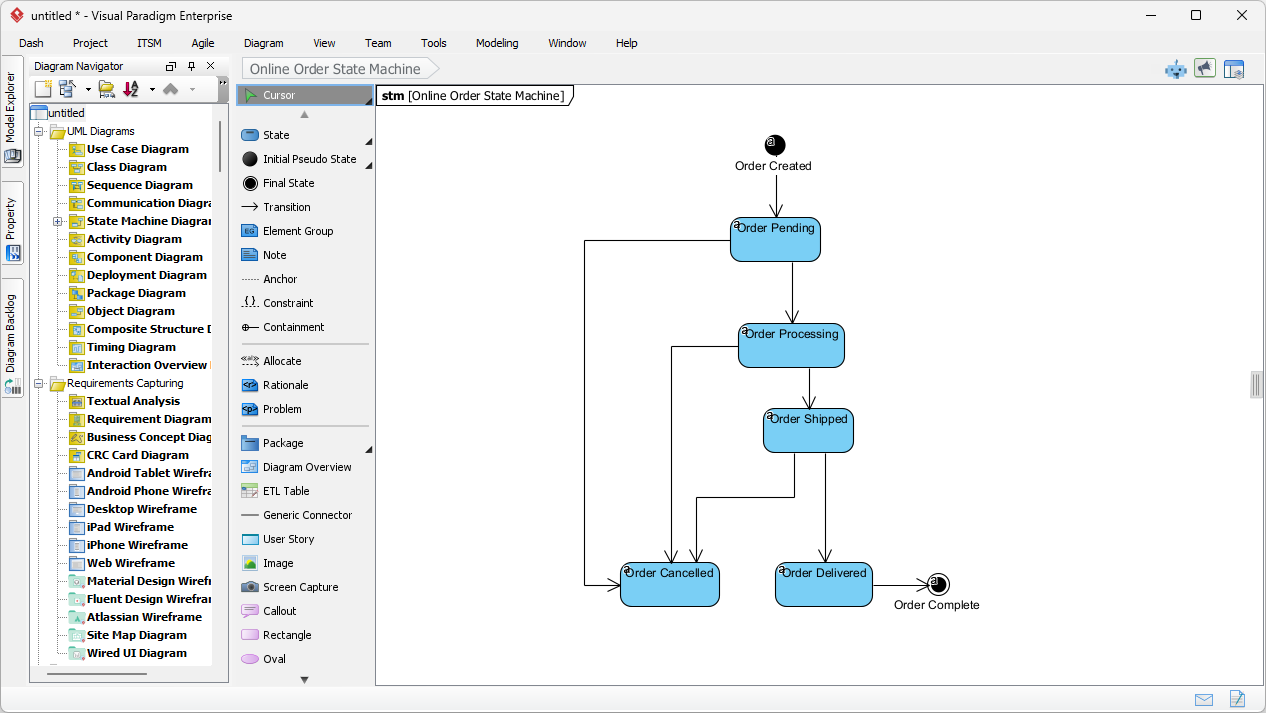
- Initial state → Created
- States: Pending Payment, Paid, Processing, Shipped, Delivered, Cancelled
- Transitions with events (e.g., paymentReceived) and guards ([stock available])
- Final states for Delivered and Cancelled
Here’s the resulting online order state machine — logical, well-arranged, and ready for refinement:
Immediately edit: add entry/exit actions, composite states, or link to sequence diagrams.
2. Chatbot: Conversational State Modeling
For rapid prototyping or brainstorming:
Open the Visual Paradigm AI Chatbot and type:
“Generate UML state machine for a support ticket: starts Open, then Assigned, In Progress, On Hold, Resolved, Closed. Include transitions for agent actions and customer feedback.”
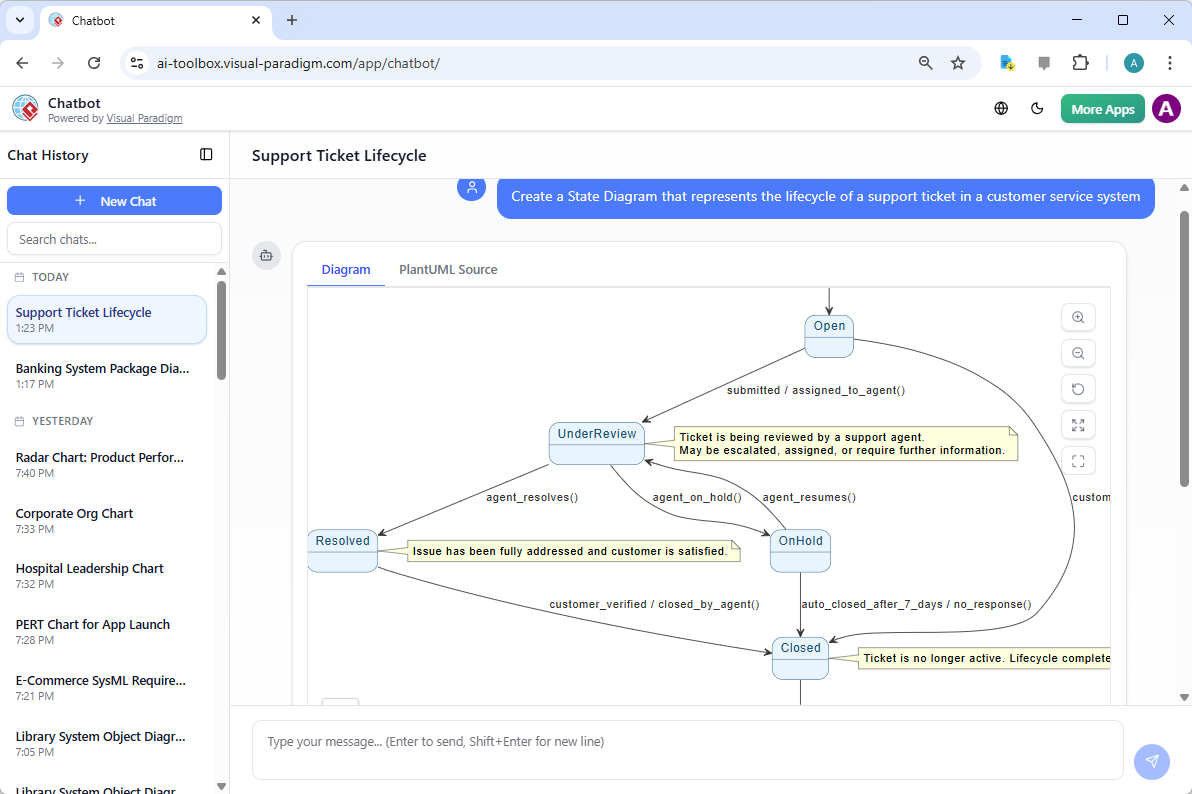
The chatbot builds it live — states, transitions, and guards appear instantly. Example output for a support ticket lifecycle:
Refine in real time: “Add Rejected state after Resolved if customer unhappy.” Instant update. Perfect for quick validation, teaching UML, or remote collaboration.
Why State Machines + AI Are Essential in 2026
State machines define reactive behavior — how systems respond to events over time. They’re critical for:
- E-commerce order flows
- Workflow engines
- Embedded systems & protocols
- UI state logic
Manual creation slows architecture down. AI removes the friction: describe the lifecycle → get structure → refine logic. That speed lets you explore edge cases, validate requirements, and communicate behavior clearly — before writing code.
Ready to Model Any Lifecycle Effortlessly?
Visual Paradigm’s AI State Machine Diagram Generator makes behavioral modeling fast, precise, and professional — whether for orders, tickets, sessions, or complex protocols.
- Download Visual Paradigm Desktop → Full power & integration: Get Desktop Now
- Try AI Chatbot Online → Instant state machines anywhere: Start Chatting
Stop drawing states by hand. Start visualizing behavior smarter — today.
Related Links
The integration of artificial intelligence with UML state machine diagrams enables developers to automate the modeling of complex system behaviors, facilitating the rapid transition from high-level behavioral design to executable source code,,.
- Mastering State Diagrams with Visual Paradigm AI: A Guide for Automated Toll Systems: This guide demonstrates how AI-enhanced state diagrams can be used to model and automate complex behaviors in specialized software systems.
- AI-Powered UML Chatbot State Diagrams: This article explores the ways AI improves both the creation and interpretation of UML state diagrams specifically for chatbot system logic.
- Definitive Guide to UML State Machine Diagrams with AI: This comprehensive resource details how to use AI-enhanced tools to accurately model dynamic object behavior and state transitions.
- What is a State Machine Diagram? A Comprehensive Guide: An in-depth overview that explains the components, purpose, and real-world applications of state machine diagrams in system design.
- State Diagram Quick Tutorial: Master UML State Machines in Minutes: A beginner-friendly tutorial focusing on the core concepts and practical modeling of UML state machines.
- Generating Source Code from State Machines in Visual Paradigm: This guide explains how to generate source code directly from diagrams to efficiently implement complex state-driven logic.
- State Machine vs Activity Diagram: Key Differences: A comparative article that clarifies the distinct roles these diagrams play in representing system behavior versus workflow logic.
- Modeling Behavior with State Diagrams in SysML: This resource provides instructions on using state diagrams within the SysML framework to model system transitions and behavioral logic.
- Interactive State Machine Diagram Tool: This web-based interface allows for the collaborative creation and real-time editing of detailed state machine diagrams.
- Free State Machine Diagram Templates: A collection of professionally designed templates available to help users jumpstart their behavior modeling and state transition projects.